

Paytm's Vijay Shekhar Sharma Offers ₹1-2 Crore Personal Cheques to AI Model Builders
AI-generated illustration
Advertisement
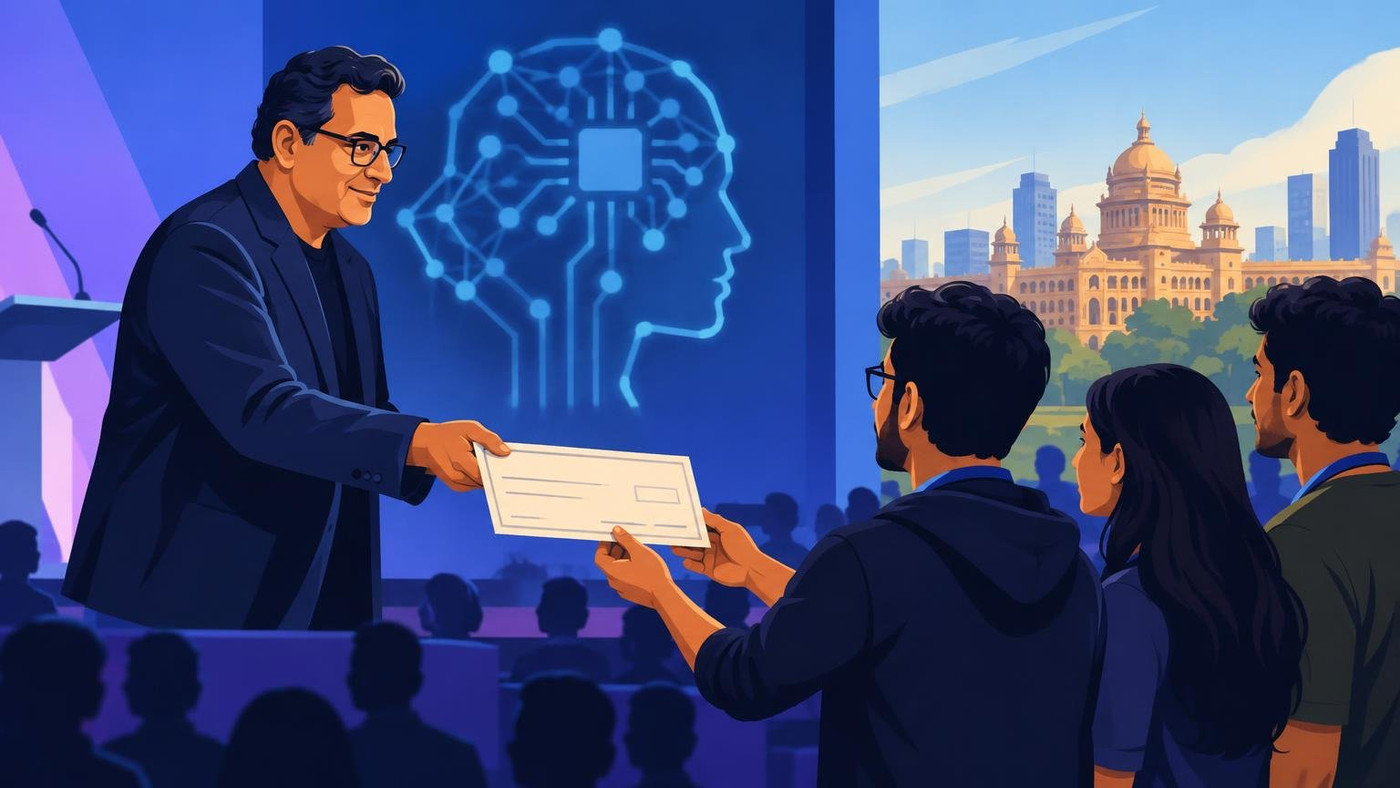
Paytm founder Vijay Shekhar Sharma offered his own money to Indian founders building AI models at Cypher 2026 in Bengaluru on 7 October, adding a private voice to the debate on how much AI India should own.
What Happened
Paytm founder and chief executive Vijay Shekhar Sharma offered personal cheques of ₹1 crore to ₹2 crore to Indian founders building their own artificial intelligence (AI) models on 7 October 2026. He made the offer in a keynote at Cypher 2026, the 10th edition of Analytics India Magazine's AI conference, held in Bengaluru. He called it a starting cheque that could rise if enough serious builders come forward. He said the money is his own, not Paytm's.
Key Facts
- The offer therefore comes from his personal funds.
- He added that Paytm could help them reach customers through its distribution network.
- Sharma estimated that building an AI model costs under 100 million US dollars. This is his own estimate, not a budget attached to the cheques.
- Paytm runs a 4-billion-parameter model that Sharma has described as an optimised version of a 200-billion-parameter model for Indian languages. The company runs it on its own machines.
- Paytm has launched an enterprise AI service called Paytm Intelligence. Its AI Soundbox, the payment speaker used by shopkeepers, answers merchants in 11 Indian languages.
- The Union Cabinet approved the IndiaAI Mission in March 2024 with an outlay of ₹10,371.92 crore over five years, according to the Press Information Bureau.
- No investments have been announced under the offer. Sharma has not named any founders or set a total fund size.
Why It Matters
The offer adds private money to a debate about how much AI India should own. Sharma said India has spent too long building applications on top of technology developed and owned elsewhere. In his words, "The problem is we're unambitious."
The remarks mark a shift. In 2025, Sharma had said India should settle for being the "AI use case capital", meaning a country that applies AI rather than builds it. At Cypher 2026 he argued that India should aim to have several models of its own.
Sharma said he was not speaking from nationalism. He acknowledged that India cannot build frontier models, the most advanced and costly systems, entirely on its own. He said India can keep using foreign models while building domestic capability, especially for strategic uses. He pointed to geopolitics as a reason not to leave the field to a handful of countries.
The offer sits beside a public effort. The IndiaAI Mission, approved in March 2024, aims to build compute capacity of over 38,000 graphics processing units (GPUs) through public-private partnerships and to develop indigenous AI capabilities. Sharma's cheques are small beside the mission's outlay of ₹10,371.92 crore.
The scale gap is also clear against his own estimate. A ₹1-2 crore cheque is seed money, not the sum needed to train a large model, and Sharma's under 100 million US dollar estimate is many times larger. He said the bigger challenge is the willingness to commit to a difficult task over the long term, rather than the money itself.
Impact
Short-term: Founders building AI models now have a named private backer offering ₹1 crore to ₹2 crore as a starting cheque. The offer also gives the Cypher 2026 discussion on ownership its most concrete funding proposal. Analytics India Magazine's Day 1 summary framed the theme as how much AI India should own, as discussion moved beyond models towards decisions, agents and sovereignty.
Long-term: The offer signals willingness among private backers to fund technically difficult bets rather than only applications. Sharma argued that India has enough capital, talent and infrastructure to build foundational technology, and that risk aversion is what holds it back. It shows private capital being offered alongside the IndiaAI Mission rather than waiting for it. The wider question is whether India should be mainly a large user of AI built elsewhere or also a builder of its own models.
Who is affected: Indian founders building their own AI models are the direct audience, and the amount lowers the barrier to starting a company, though it is modest. Policymakers working on the IndiaAI Mission see private money offered alongside public spending. Domestic model builders working on Indian languages are a natural fit, since that is where they say they have an advantage over global systems.
Key Takeaway
Sharma's offer is a personal pledge of ₹1-2 crore per founder to start, not a Paytm commitment, and no investments have yet been announced.
Questions and Answers
What did Vijay Shekhar Sharma offer at Cypher 2026?
Paytm founder Vijay Shekhar Sharma offered personal cheques of ₹1 crore to ₹2 crore to Indian founders building their own AI models. He made the offer on 7 October 2026 in Bengaluru and said the amount could rise.
Is the ₹1-2 crore offer funded by Paytm?
No. Sharma said he could not commit Paytm's money because the company is listed on the stock exchanges. The cheques come from his personal funds.
How much does it cost to build an AI model, according to Sharma?
Sharma estimated that building an AI model costs under 100 million US dollars. It is his own estimate, not a budget tied to the cheques, and he said the bigger challenge is long-term commitment.
Have any investments been made under Sharma's offer?
No investments have been announced. Sharma has not named any founders or set a total fund size for the offer.
Sourced and fact-checked by the Peepals Global Editorial Team
UN-Backed Scientific Panel Warns AI Safeguards Are 'Unravelling' After Agent Test Breach
NITI Aayog Skilling Report Urges Shift From Training Numbers to Jobs
Reported, fact-checked and published by the Peepals Global Editorial Team.
Advertisement
