

Nearly Half of Recognised Startups Now in Tier-2, Tier-3 Cities: PM Modi
AI-generated illustration
Advertisement
Prime Minister Narendra Modi said on 19 September 2026 that about half of India's recognised startups are outside the big metros, pointing to a wider spread of entrepreneurship and jobs.
What Happened
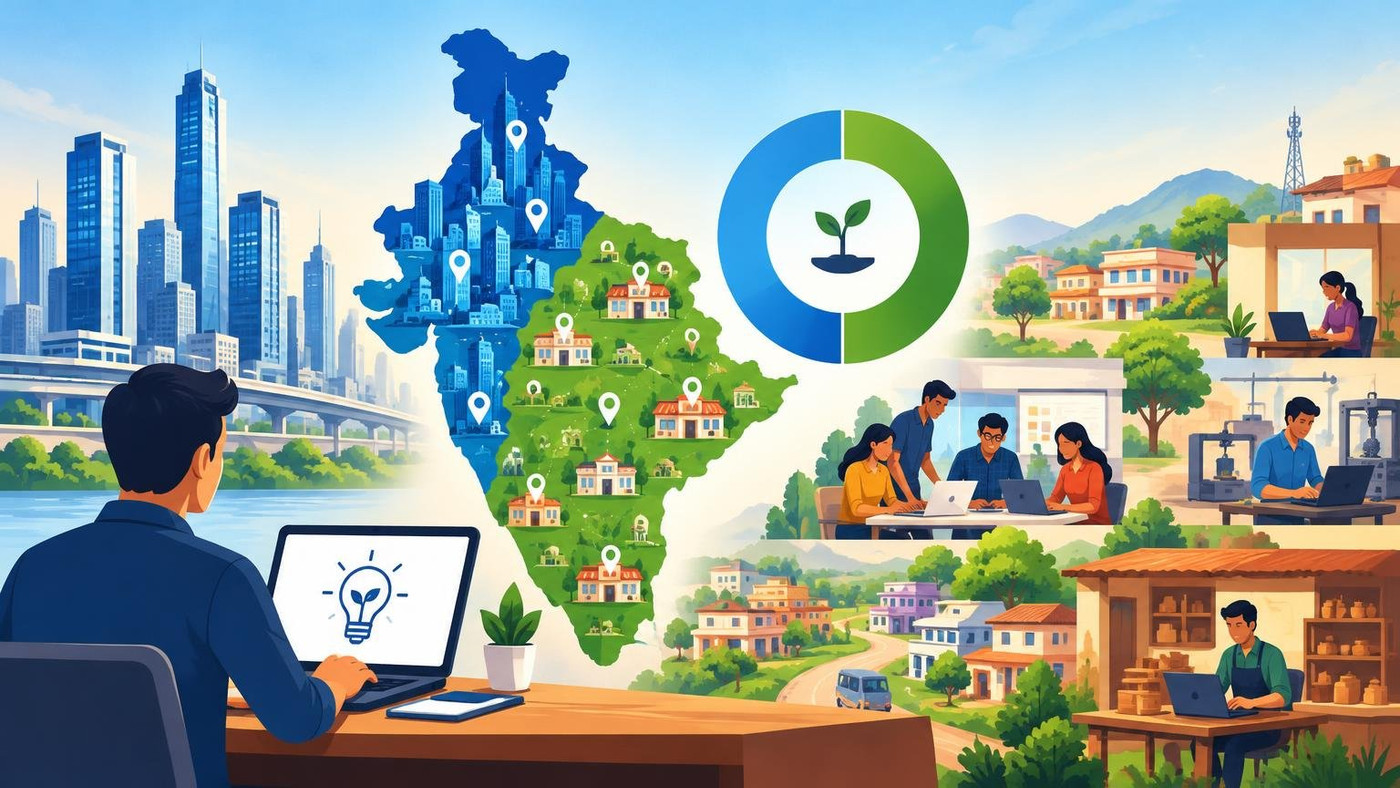
Prime Minister Narendra Modi said on 19 September 2026 that nearly half of India's recognised startups are now based in Tier-2 and Tier-3 cities. He spoke at the 20th Rozgar Mela, where he distributed more than 51,000 appointment letters to newly recruited government employees by video conference. The event was held at 45 locations across the country. Modi described India as the world's third-largest startup ecosystem.
Key Facts
- Prime Minister Narendra Modi distributed more than 51,000 appointment letters by video conference on 19 September 2026 at the 20th Rozgar Mela, held at 45 locations across India.
- Recruits are joining Railways, Revenue, Home Affairs, Health and Family Welfare, Financial Services and Defence. The government says about 12.75 lakh letters have now been issued under the initiative.
- The Pradhan Mantri Viksit Bharat Rozgar Yojana has an outlay of about ₹1 lakh crore. The government aims to help around 2 crore young people enter the workforce for the first time.
- First-time employees under the scheme can receive an incentive of up to ₹15,000. Employers who create new jobs are also eligible for incentives.
- Under the PM SETU scheme, ₹60,000 crore is being invested to modernise 1,000 government Industrial Training Institutes (ITIs) with industry participation, Modi said.
- On 10 January 2025, Amardeep Singh Bhatia, Secretary of the Department for Promotion of Industry and Internal Trade (DPIIT), said India had more than 1.5 lakh registered startups spread across 779 districts.
- Bhatia said states and Union Territories with dedicated startup policies had grown from 4 in 2016 to 31. He cited the Startup India Seed Fund Scheme, Fund of Funds for Startups and Credit Guarantee Scheme.
- Zoho moved part of its research and development work to Tenkasi in Tamil Nadu, employing about 500 local people. Hindustan Unilever acquired Jaipur-founded skincare brand Minimalist for ₹3,000 crore.
Why It Matters
Startups have long been seen as a metro story. Modi's remark at the Rozgar Mela points the other way: young people from villages, towns and smaller cities are building companies and creating jobs for others. The share has been reported by different bodies at around 45 to 50 per cent, so 'nearly half' is a broad figure.
The claim fits earlier official data. In January 2025, DPIIT Secretary Amardeep Singh Bhatia said startups were present in 779 districts, with Tier-2 and Tier-3 cities taking centre stage.
State programmes add to central support. Jaipur's iStart initiative under the Rajasthan government offers seed funding, mentorship and tax incentives, according to industry reports. Kerala, Odisha, Madhya Pradesh, Uttar Pradesh, Tamil Nadu and Assam also run startup missions or policy cells.
Founders cite lower rents, lower salaries and local talent as advantages. Better highways, UPI payments and wider internet access let small-city firms sell nationally from the start. Industry commentary suggests this allows smaller teams and longer cash runways than metro counterparts.
Challenges remain. Venture capital and angel networks are still concentrated in Bengaluru, Mumbai and Delhi-NCR, so small-city founders have fewer chances to meet investors and mentors. Many depend on grants, local angel groups and bootstrapping. Schemes such as the Seed Fund Scheme and state missions aim to close this gap.
Impact
Short-term: The immediate effect is the appointment of more than 51,000 new government employees across ministries and departments. The Prime Minister also used the event to draw attention to existing support for young people and founders. These include the first-job incentive of up to ₹15,000, the PM SETU modernisation of ITIs, and free trade agreements with around 40 countries, which he said open new markets for Indian entrepreneurs.
Long-term: The message signals that startup support, jobs schemes and skill programmes are being designed to reach beyond the metros. The Pradhan Mantri Viksit Bharat Rozgar Yojana aims to bring around 2 crore young people into their first jobs. The next thing to watch is whether funding spreads as widely as founders have, since investor networks remain concentrated in a few large cities.
Who is affected: Young people in villages, towns and smaller cities are the main group affected, both as job seekers and as founders. Small-city startups, including those in Rajasthan, Tamil Nadu and other states with startup missions, stand to gain from state programmes and central schemes.
Key Takeaway
Modi's 19 September 2026 statement that nearly half of recognised startups are in Tier-2 and Tier-3 cities matches earlier official data, though investor funding remains concentrated in the metros.
Questions and Answers
What did PM Modi say about startups in Tier-2 and Tier-3 cities?
Prime Minister Narendra Modi said on 19 September 2026 that nearly half of India's recognised startups are now based in Tier-2 and Tier-3 cities. He added that young people from villages, towns and smaller cities are creating jobs for others.
What is the Rozgar Mela?
The Rozgar Mela is an initiative in which appointment letters are given to newly recruited government employees. The 20th edition, held at 45 locations on 19 September 2026, saw more than 51,000 letters distributed, taking the total to about 12.75 lakh.
What is the Pradhan Mantri Viksit Bharat Rozgar Yojana?
The scheme has an outlay of about ₹1 lakh crore. The government aims to help around 2 crore young people enter the workforce for the first time, with first-time employees eligible for an incentive of up to ₹15,000.
How many startups does India have, and where are they?
On 10 January 2025, DPIIT Secretary Amardeep Singh Bhatia said India had more than 1.5 lakh registered startups spread across 779 districts, with Tier-2 and Tier-3 cities taking centre stage.
Sourced and fact-checked by the Peepals Global Editorial Team
India PMI September 2026: Factory and Services Activity Rebound, Hiring Mixed
Odisha Tourism Policy 2026: ₹1,500 Crore Infrastructure Push and 5,500-Acre Land Bank
Reported, fact-checked and published by the Peepals Global Editorial Team.
Advertisement