
India PMI September 2026: Factory and Services Activity Rebound, Hiring Mixed
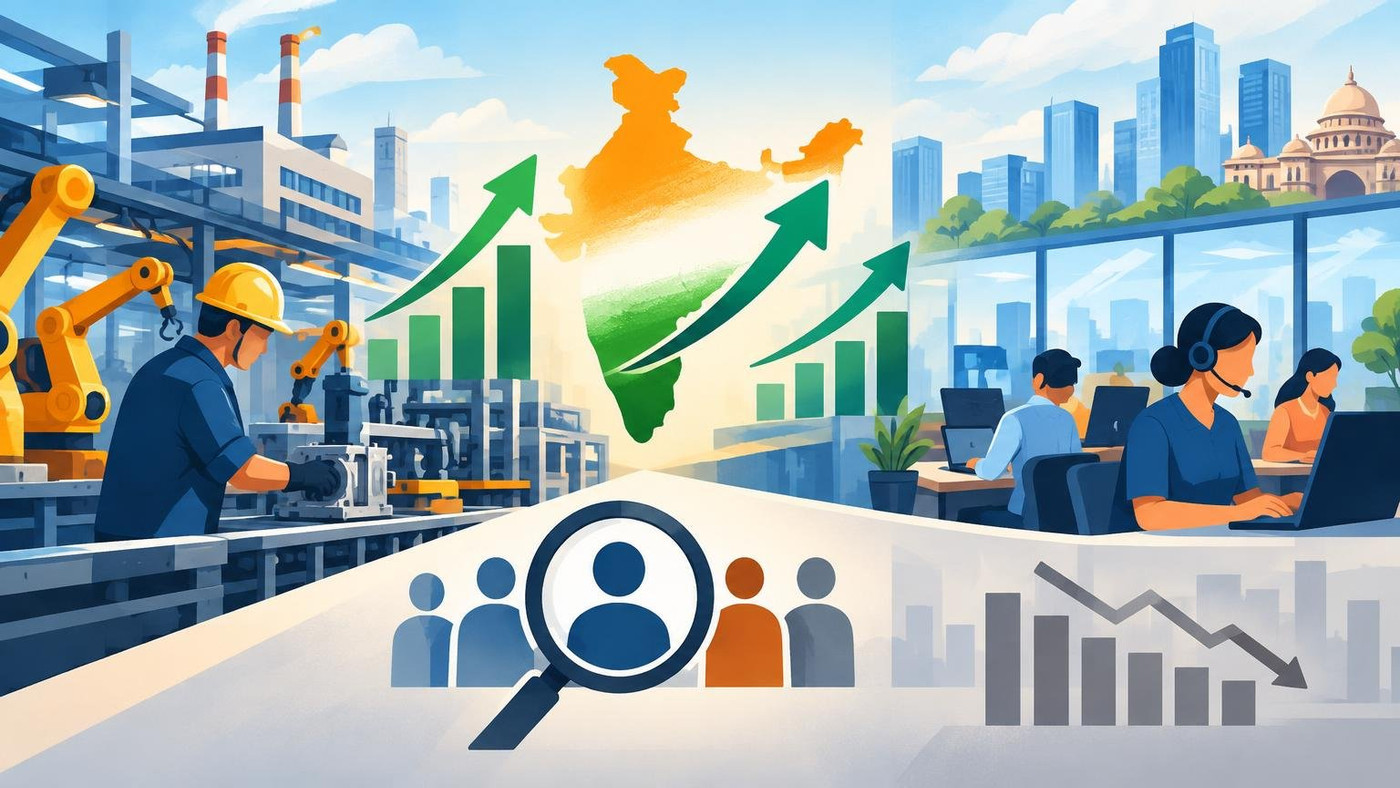
AI-generated illustration
Advertisement
India's private sector grew faster in September 2026, with the manufacturing PMI at 55.1 and services at 55.2, but quarterly averages remain the weakest in years.
What Happened
India's private sector activity picked up in September 2026, according to HSBC's Purchasing Managers' Index (PMI) surveys compiled by S&P Global. The manufacturing PMI, released on 1 October 2026, rose to 55.1. The services PMI stood at 55.2. Together they lifted the India Composite PMI to 55.9, a three-month high. A reading above 50 signals expansion.
Key Facts
- The HSBC India Manufacturing PMI rose to 55.1 in September 2026 from 52.8 in August. It is the highest since February 2026, when the index stood at 56.9.
- The manufacturing reading was below the preliminary flash estimate of 55.7 released on 23 September 2026. Factory activity expanded after three straight months of slowing.
- New factory orders grew at their fastest pace since February 2026. Demand for electronic, food, pharmaceutical and textile products lifted new business, while capital goods were the weakest segment.
- Factory employment returned to growth in September after falling in August. The rise was the fastest since May 2026, and August's fall was the first in two and a half years.
- The HSBC India Services PMI rose to 55.2 in September from 54.1 in August, below the flash estimate of 55.8. Services activity has stayed above 50 for 62 consecutive months.
- New export orders in services grew at their weakest pace in nearly three years. Services employment growth eased from August, although firms continued to add staff.
- The average manufacturing PMI for July-September 2026 was 53.8, the lowest for that quarter since 2021. The composite average was the weakest since the quarter ended March 2022.
- Industrial output growth quickened to 8 per cent in August 2026 on manufacturing and power. The Economic Survey 2025-26 says MSMEs account for 31.1 per cent of GDP and 48.58 per cent of exports.
Why It Matters
The PMI gives an early reading of how factories and service firms are doing, well before official output data arrive. September's figures show a clear monthly rebound.
The quarterly view tempers the gains. September's rebound followed a soft August and a slow summer. One strong month does not yet confirm a lasting recovery.
Jobs are the most direct link to household incomes. Factory hiring resumed after the August decline, and business confidence reached a four-month high. In services, hiring continued but at a slower pace. Only 16 per cent of surveyed service firms expect output to grow over the next 12 months, even as confidence reached a three-month high.
Other indicators add context. A weak monsoon has raised concerns about rural incomes and demand, which matter for small makers of consumer goods, tractors and farm inputs. The PMI surveys cover private firms and do not measure agriculture, so they do not capture that pressure directly.
Costs and borrowing are a watch point. Market commentary noted rising input costs and expectations of further interest rate moves by the Reserve Bank of India (RBI). Higher rates affect micro, small and medium enterprises (MSMEs), which rely on working-capital loans. As of August 2026, 9.16 crore enterprises were registered on the Udyam platform, employing more than 40 crore people.
Impact
Short-term: Factories are buying more raw materials and building stocks in preparation for expected sales, and hiring has restarted after August's fall. Export orders rose at a quicker pace, with clients in Brazil, Europe, the UAE and the US cited. For small manufacturers in textiles and pharmaceuticals, overseas orders support capacity use and staffing. In services, domestic customers drove September's gain, with new business growing at its fastest pace since June.
Long-term: Whether September marks a turning point will depend on coming data. The next HSBC flash PMI readings for October are due later this month, and final figures follow in early November 2026. Festival-season demand, export orders, and the RBI's rate path are the main factors to track. Capital goods orders, the weakest segment in September, will show whether firms are ready to invest. The Micro, Small and Medium Enterprises Development (Amendment) Act, 2026 backs mechanisms for delayed dues, which can ease cash pressure when orders pick up.
Who is affected: Manufacturers in electronics, food, pharmaceuticals and textiles are the main beneficiaries of firmer demand. Factory workers gain from the return of hiring. Service firms in financial, consumer and digital segments saw demand rise. MSMEs are exposed to input costs and borrowing costs. Rural households and the small firms serving them face pressure from the weak monsoon. The survey did not break down results by state or firm size, so regional effects cannot be read from this release.
Key Takeaway
India's September 2026 PMIs show a clear monthly rebound, with manufacturing at 55.1, services at 55.2 and the composite at 55.9, but July-September averages were the weakest in more than four years.
Questions and Answers
What was India's manufacturing PMI in September 2026?
India's HSBC Manufacturing PMI rose to 55.1 in September 2026 from 52.8 in August. It is the highest since February 2026 but below the flash estimate of 55.7 released on 23 September 2026.
What was India's services PMI in September 2026?
The HSBC India Services PMI rose to 55.2 in September 2026 from 54.1 in August. New business grew at its fastest pace since June, and activity has stayed above 50 for 62 consecutive months.
What does a PMI reading above 50 mean?
A PMI reading above 50 signals expansion in private sector activity. India's Composite PMI reached 55.9 in September 2026, a three-month high, so both manufacturing and services expanded.
Is India's economic recovery confirmed by the September PMI?
Not yet. The July-September manufacturing average of 53.8 was the lowest for that quarter since 2021, and the composite average was the weakest since March 2022. One strong month does not confirm a lasting recovery.
Sourced and fact-checked by the Peepals Global Editorial Team
SAREX 2026: Coast Guard Holds Mass Rescue Drill Off Paradip With 30 Nations
Nearly Half of Recognised Startups Now in Tier-2, Tier-3 Cities: PM Modi
Reported, fact-checked and published by the Peepals Global Editorial Team.
Advertisement