

RBI Hikes Repo Rate to 5.50%, Raises FY27 GDP Forecast to 7.1%
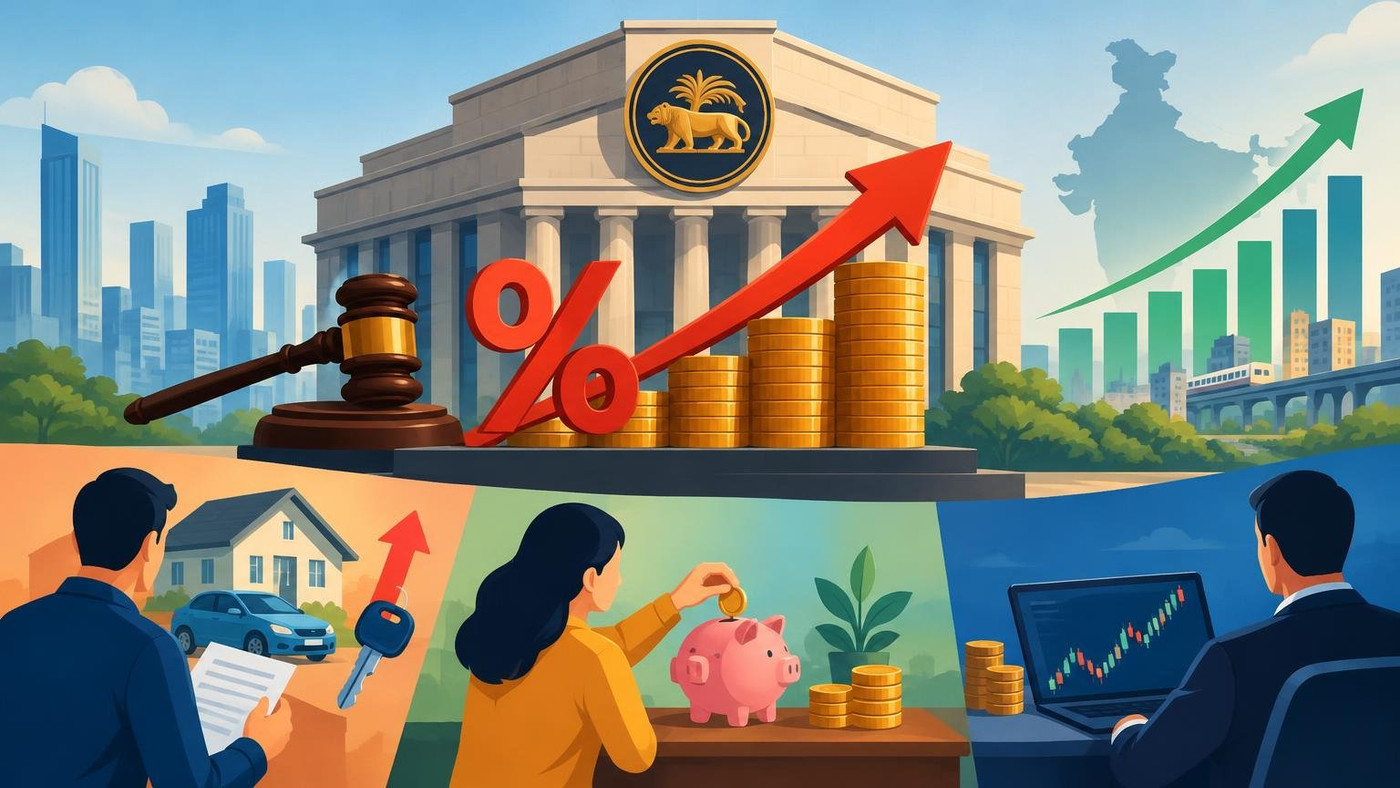
AI-generated illustration
Advertisement
The RBI raised the repo rate by 25 basis points on 7 October 2026 and shifted to a tightening stance, a move that affects borrowers, savers and investors.
What Happened
The Reserve Bank of India (RBI) raised the repo rate by 25 basis points to 5.50 per cent from 5.25 per cent on 7 October 2026. The decision followed the 63rd meeting of the Monetary Policy Committee (MPC), held from 5 to 7 October under Governor Sanjay Malhotra. The six-member MPC voted unanimously and changed the policy stance from neutral to "calibrated tightening". It is the first repo rate hike since February 2023.
Key Facts
- It is the first hike since February 2023 and ends a pause that followed the 2025 easing cycle.
- The RBI said the decision responds to rising inflationary pressures and uncertainty in the global economy.
- The Standing Deposit Facility (SDF) rate is now 5.25 per cent. Other policy rates moved in step with the repo rate, setting the floor and ceiling of the overnight corridor for banks.
- The RBI raised its FY27 consumer price index (CPI) inflation forecast to 5.2 per cent from 5.0 per cent. Retail inflation is projected to stay above the 4 per cent medium-term target through the year.
- The RBI lifted its FY27 real GDP growth forecast to 7.1 per cent from 6.7 per cent. Q4 growth stays at 6.8 per cent.
- Growth for the July-September quarter (Q2 FY27) is now seen at 7.2 per cent against 6.4 per cent earlier.
- ICICI Bank's research report expects back-to-back hikes over the next two policy meetings and a terminal repo rate of around 6 per cent. This is an analyst projection, not an RBI commitment.
Why It Matters
The repo rate is the rate at which the RBI lends short-term money to banks. It guides borrowing costs across the economy, so a change affects loans, deposits and investment decisions.
The backdrop includes higher crude oil prices, a weaker rupee and uncertainty over global trade.
The RBI paired the hike with a higher growth outlook. Faster growth with higher inflation explains the decision, because a stronger economy gives the central bank room to raise rates without choking demand. Manufacturing activity and goods and services tax collections earlier this month also pointed to firm demand.
The forecast changes are shown below.
| Indicator | Earlier | Now |
|---|---|---|
| FY27 CPI inflation | 5.0% | 5.2% |
| FY27 GDP growth | 6.7% | 7.1% |
| Q2 FY27 growth | 6.4% | 7.2% |
| Q3 FY27 growth | 6.5% | 6.9% |
ICICI Bank's research report notes that recent price pressures stem mainly from food and energy supply factors, not broad demand, and remain concentrated in selected categories. The RBI is signalling that it prefers to act early to stop price pressures from spreading.
Impact
Short-term: Loans linked to the repo rate are affected first. Many home, vehicle and personal loans on floating rates are tied to it. Banks reset these rates at intervals, so equated monthly instalments (EMIs) or loan tenures can rise over the coming months. Borrowers with fixed-rate loans are not affected until they refinance. For businesses, especially micro, small and medium enterprises (MSMEs), working-capital loans and external-benchmark-linked credit lines tend to reprice first. Higher funding costs may squeeze thin margins and delay expansion plans.
Long-term: The change to calibrated tightening means future moves will depend on incoming data. Key numbers to watch are monthly CPI inflation, crude oil prices, the rupee and the next quarterly GDP release. ICICI Bank's research report expects further hikes and a terminal repo rate of around 6 per cent, though this is an analyst projection. The MPC's next scheduled meeting will set the direction for borrowing costs into 2027. The longer-term market effect depends on how far the RBI goes.
Who is affected: Borrowers with large floating-rate debt face higher costs, while fixed-rate borrowers are protected until they refinance. Savers may gain: banks usually raise deposit rates after a policy rate increase, though at different speeds, and fixed deposit rates may stabilise or edge up. Firms with strong cash flows and low debt are better placed. Investors will watch bond yields, bank margins and the rupee. Real estate, autos and consumer durables are usually sensitive to rate hikes, and banks may see pressure on deposit costs even as loan yields rise.
Key Takeaway
The repo rate stands at 5.50 per cent after a unanimous 25-basis-point hike on 7 October 2026, with the RBI projecting FY27 growth of 7.1 per cent and inflation of 5.2 per cent.
Questions and Answers
What is the new RBI repo rate after the October 2026 policy?
The Reserve Bank of India raised the repo rate by 25 basis points to 5.50 per cent from 5.25 per cent on 7 October 2026. The Monetary Policy Committee voted unanimously for the hike.
Why did the RBI raise the repo rate?
The RBI said the decision responds to rising inflationary pressures and global uncertainty. It raised its FY27 CPI inflation forecast to 5.2 per cent, while growth is projected at 7.1 per cent.
How will the repo rate hike affect home loan EMIs?
Floating-rate home, vehicle and personal loans tied to the repo rate can see higher EMIs or longer tenures over the coming months as banks reset rates. Fixed-rate borrowers are unaffected until they refinance.
Will the RBI raise rates again?
The RBI has not committed to further hikes. ICICI Bank's research report expects back-to-back hikes over the next two meetings and a terminal repo rate of around 6 per cent.
Sourced and fact-checked by the Peepals Global Editorial Team
Faceless GST Assessment: Centre Plans Rollout for 2 Lakh Multi-Jurisdiction Taxpayers in FY28
India CPI Inflation Broadens Beyond Food and Fuel: What It Means
Reported, fact-checked and published by the Peepals Global Editorial Team.
Advertisement