

Supreme Court rejects Andhra plea to restore 34% BC quota in local body polls
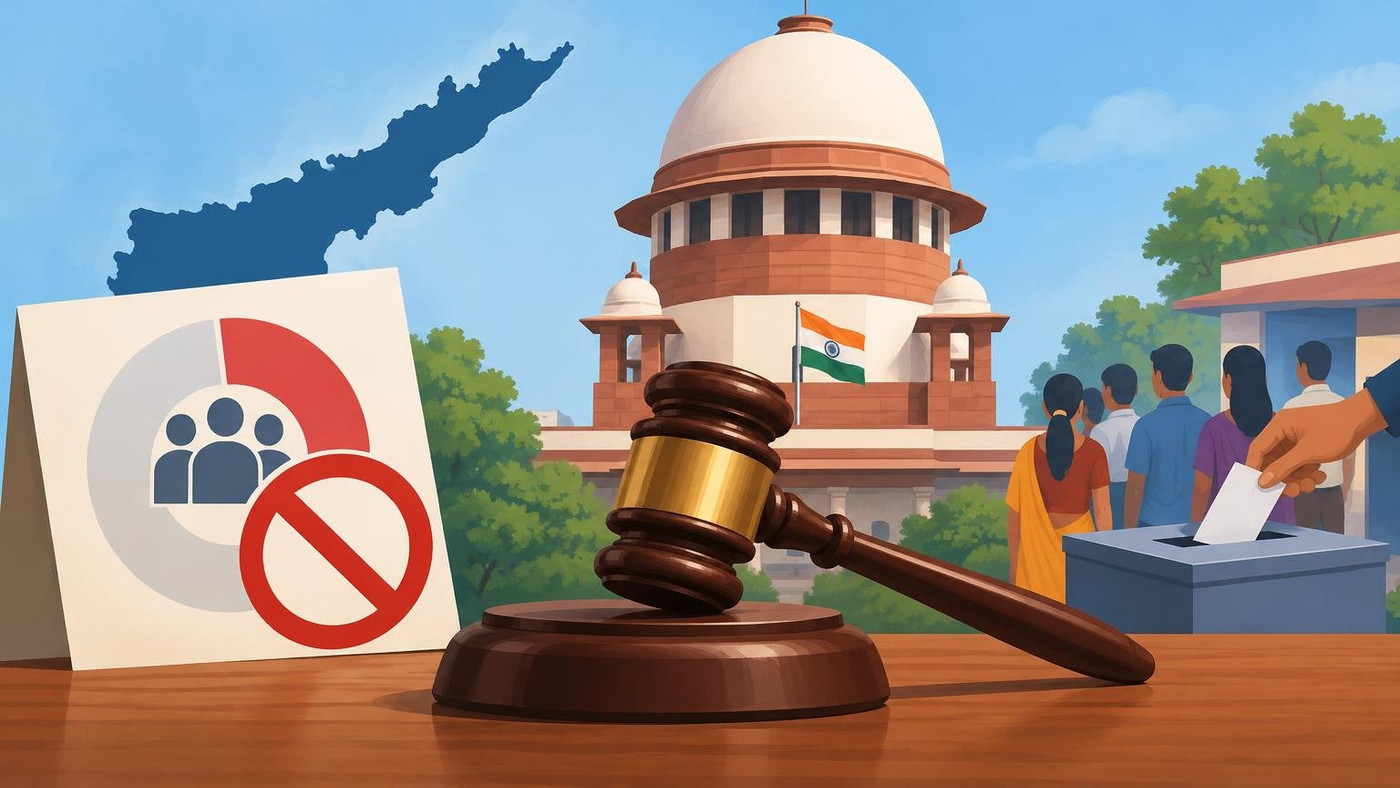
AI-generated illustration
Advertisement
The Supreme Court on 9 October 2026 dismissed Andhra Pradesh's challenge to a High Court order quashing 34% BC reservation in local body elections.
What Happened
The Supreme Court on Friday, 9 October 2026, dismissed the Andhra Pradesh government's challenge to a High Court ruling that struck down 34 per cent reservation for Backward Classes (BCs) in the state's rural and urban local body elections. A bench of Justices Dipankar Datta and Sheel Nagu declined to interfere with the Andhra Pradesh High Court's order of 1 October 2026, which had quashed two government orders setting the quota. The High Court found that the quota pushed total reservation in local bodies above the 50 per cent ceiling laid down by the Supreme Court, without the empirical data needed to justify such a breach. With the appeal rejected, the way is clear for local body elections to be held on the High Court's terms.
Key Facts
- Court: Supreme Court bench of Justices Dipankar Datta and Sheel Nagu, on 9 October 2026.
- Decision: dismissed the Andhra Pradesh government's challenge to the High Court's 1 October ruling.
- What was struck down: two government orders providing 34 per cent BC reservation in rural and urban local body polls.
- Main reason: total reservation went beyond the 50 per cent ceiling set in the 1992 Indra Sawhney judgment, without adequate empirical data.
- The bench questioned the state's reliance on a family survey and asked under what law it had been conducted.
- The High Court had directed the state and the State Election Commission to start the election process within six weeks.
- The State Election Commissioner said the poll schedule would be announced soon after the Supreme Court's decision.
Why It Matters
Reservation in local bodies such as panchayats and municipalities decides who can contest a large number of seats, from village sarpanch posts to municipal wards. Raising the BC share to 34 per cent was a major political promise in Andhra Pradesh, announced by Chief Minister N. Chandrababu Naidu on 18 August. The Supreme Court's refusal to step in means the state cannot use that quota in the coming elections in its current form.
The case turns on a rule that has shaped reservation policy across India for more than three decades: total reservation should not normally exceed 50 per cent, and any exception needs strong evidence. In this case, reports said the commission's report had been submitted but not accepted by the state government, and the bench was not satisfied with the family survey the state relied on.
The decision has effects beyond Andhra Pradesh. Other states that want higher quotas in local bodies will read it as a reminder that political announcements must be backed by data that can survive legal scrutiny. For voters and candidates in Andhra Pradesh, it means elections are likely to go ahead soon, under reservation that stays within the legal limits.
| Step | Date |
|---|---|
| Chief Minister announces 34 per cent BC quota | 18 August 2026 |
| High Court quashes the government orders | 1 October 2026 |
| Supreme Court dismisses state's challenge | 9 October 2026 |
| Election process to start | Within six weeks of the High Court order |
Impact
Short-term: The State Election Commission is expected to announce the local body poll schedule soon. Reports suggest municipal elections may come first, followed by mandal and zilla parishad polls.
Long-term: To raise BC reservation in local bodies in future, Andhra Pradesh will need empirical data that a court accepts as justifying any quota above the 50 per cent limit.
Who is affected: Backward Class communities and their prospective candidates, political parties in Andhra Pradesh, the State Election Commission, and voters in panchayats and municipalities.
Key Takeaway
The Supreme Court on 9 October 2026 refused to revive Andhra Pradesh's 34 per cent BC quota in local body polls, upholding the High Court's finding that it breached the 50 per cent limit without adequate data.
Questions and Answers
What did the Supreme Court decide on Andhra Pradesh's BC quota?
On 9 October 2026 it dismissed the state's challenge to a High Court ruling that had quashed 34 per cent BC reservation in rural and urban local body elections.
Why was the 34 per cent quota struck down?
The High Court found that it took total reservation above the 50 per cent ceiling set in the Indra Sawhney judgment without the empirical data needed to justify going beyond that limit.
When will Andhra Pradesh hold local body elections?
The High Court told the state and the State Election Commission to begin the process within six weeks of its 1 October order. The State Election Commissioner said the schedule would be announced soon.
Can the state bring back higher BC reservation later?
Only with empirical data strong enough to justify going past the 50 per cent ceiling. The courts found that data missing this time; reports said a commission's report was submitted but not accepted by the state.
Sourced and fact-checked by the Peepals Global Editorial Team
India to host WTTC Global Summit 2027 in New Delhi
Madhya Pradesh draws Rs 90,000 crore investment proposals at Mumbai roadshow
Reported, fact-checked and published by the Peepals Global Editorial Team.
Advertisement