
Supreme Court bars full Delhi Metro shutdown ahead of Cockroach Janta Party protest
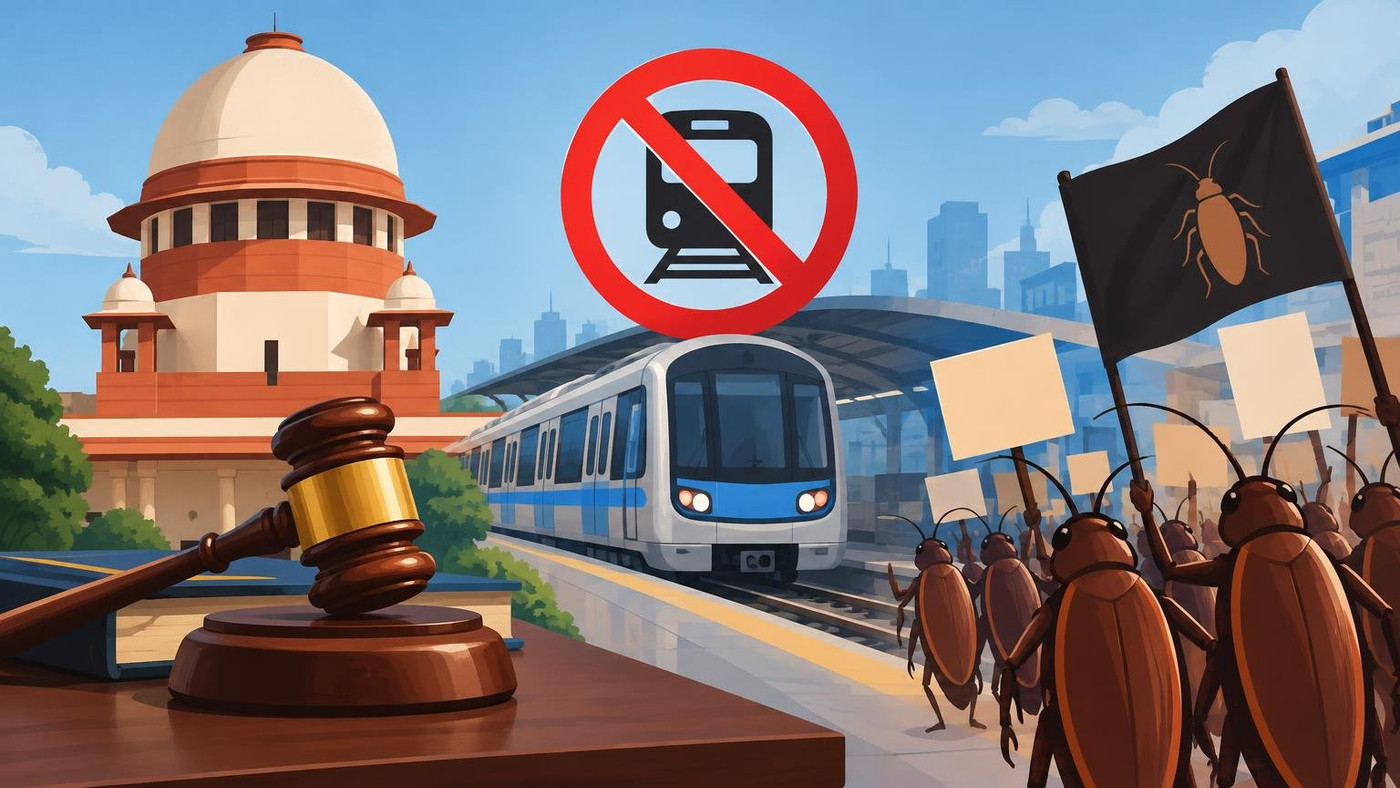
AI-generated illustration
Advertisement
The Supreme Court ruled on October 9, 2026 that Delhi Metro cannot be fully halted before the Cockroach Janta Party's October 10 protest against the CEC.
What Happened
The Supreme Court on Friday, October 9, 2026, ruled that there must be no complete halt to Delhi Metro trains ahead of a protest called in the capital for Saturday, October 10, by the Cockroach Janta Party (CJP) and other youth groups. A bench led by Chief Justice Surya Kant recorded an assurance from Solicitor General Tushar Mehta that the Centre would ask authorities to reconsider planned restrictions. The court said that, in terms of that assurance, there shall be no complete prohibition on the movement of metro trains, and told the Centre to let railway services run in a suitably regulated manner to keep public inconvenience to a minimum. The protesters are demanding the resignation of Chief Election Commissioner Gyanesh Kumar over alleged irregularities in voter-list revisions.
Key Facts
- The order was passed on Friday, October 9, 2026, by a bench led by Chief Justice Surya Kant.
- The court expressed concern over the proposed closure of 57 metro stations and the cancellation of long-distance trains ahead of the protest.
- It ruled there shall be no complete prohibition on metro train movement and asked that rail services run in a regulated way.
- The court asked the Centre to consider designating a suitable venue for such demonstrations and take an appropriate decision.
- Reports on Friday night said entry and exit were still being restricted at dozens of metro stations until Saturday evening, and a contempt plea against the closures was reported to have been filed on October 10.
- Mobile internet was ordered suspended within a 4-km radius of the Janpath and Kartavya Path crossing in central Delhi.
- The CJP said police in several states had detained thousands of its supporters travelling to the protest.
Why It Matters
The case puts two duties of the state side by side: keeping order in the capital during a large protest, and keeping a city of millions moving. Closing dozens of metro stations and cancelling trains affects far more people than the protesters themselves, including workers, students, patients and travellers. The court did not stop the police from managing crowds, but it made clear that a blanket shutdown of public transport is not an acceptable default. Its request that the Centre consider a designated venue for demonstrations points to a longer-term fix: giving protests a known place, so that authorities need not close large parts of the city.
The protest itself is about the integrity of elections. The CJP, a viral youth-led movement, and allied groups accuse the Election Commission of irregularities in recent revisions of voter lists, and want the Chief Election Commissioner to step down. Critics of the revisions say they benefited the ruling BJP. The scale of the security response, from station closures to internet suspension and detentions in several states, shows how seriously the authorities view the mobilisation.
How the order is followed matters as much as what it says. Reports that restrictions continued at many stations, and the filing of a contempt plea, mean the court may be asked to decide whether its direction was respected.
| Measure | What was planned or reported | What the court said |
|---|---|---|
| Metro services | Closure of 57 stations proposed | No complete prohibition on metro movement |
| Long-distance trains | Some cancellations | Run in a suitably regulated manner |
| Protest venue | Not designated | Centre to consider a suitable venue |
Impact
Short-term: Commuters in central Delhi face restricted station access and heavy policing on October 10, while the protest and any further court hearings will test how the order is applied.
Long-term: A designated protest venue and clearer limits on transport shutdowns could shape how Delhi handles future large demonstrations, and the debate over voter-list revisions will continue to put pressure on the Election Commission.
Who is affected: Delhi commuters and rail travellers, protesters and their families, the Delhi Police and transport authorities, and the Election Commission.
Key Takeaway
The Supreme Court ruled on October 9, 2026 that Delhi Metro could not be fully shut ahead of the Cockroach Janta Party's October 10 protest, and asked the Centre to consider a designated venue for demonstrations.
Questions and Answers
What did the Supreme Court order about Delhi Metro on October 9, 2026?
A bench led by Chief Justice Surya Kant ruled there shall be no complete prohibition on metro train movement, after recording the Solicitor General's assurance that the Centre would ask authorities to reconsider the restrictions.
Why is the Cockroach Janta Party protesting?
The CJP and other youth groups want Chief Election Commissioner Gyanesh Kumar to resign over alleged irregularities in voter-list revisions.
Were metro stations still closed on October 10?
Reports on Friday night said entry and exit remained restricted at dozens of stations until Saturday evening, and a contempt plea against the closures was reported to have been filed.
What else did the court ask the government to do?
It asked the Centre to let railway services run in a regulated way and to consider designating a suitable venue for such demonstrations.
Sourced and fact-checked by the Peepals Global Editorial Team
Poonawalla Fincorp Q2 profit jumps to Rs 375 crore as credit costs ease
CBSE opens advanced NISHTHA courses for teachers on cyber hygiene, e-waste
Reported, fact-checked and published by the Peepals Global Editorial Team.
Advertisement