

Haryana paddy farmers allege below-MSP sales as lifting lags; state vows full purchase
AI-generated illustration
Advertisement
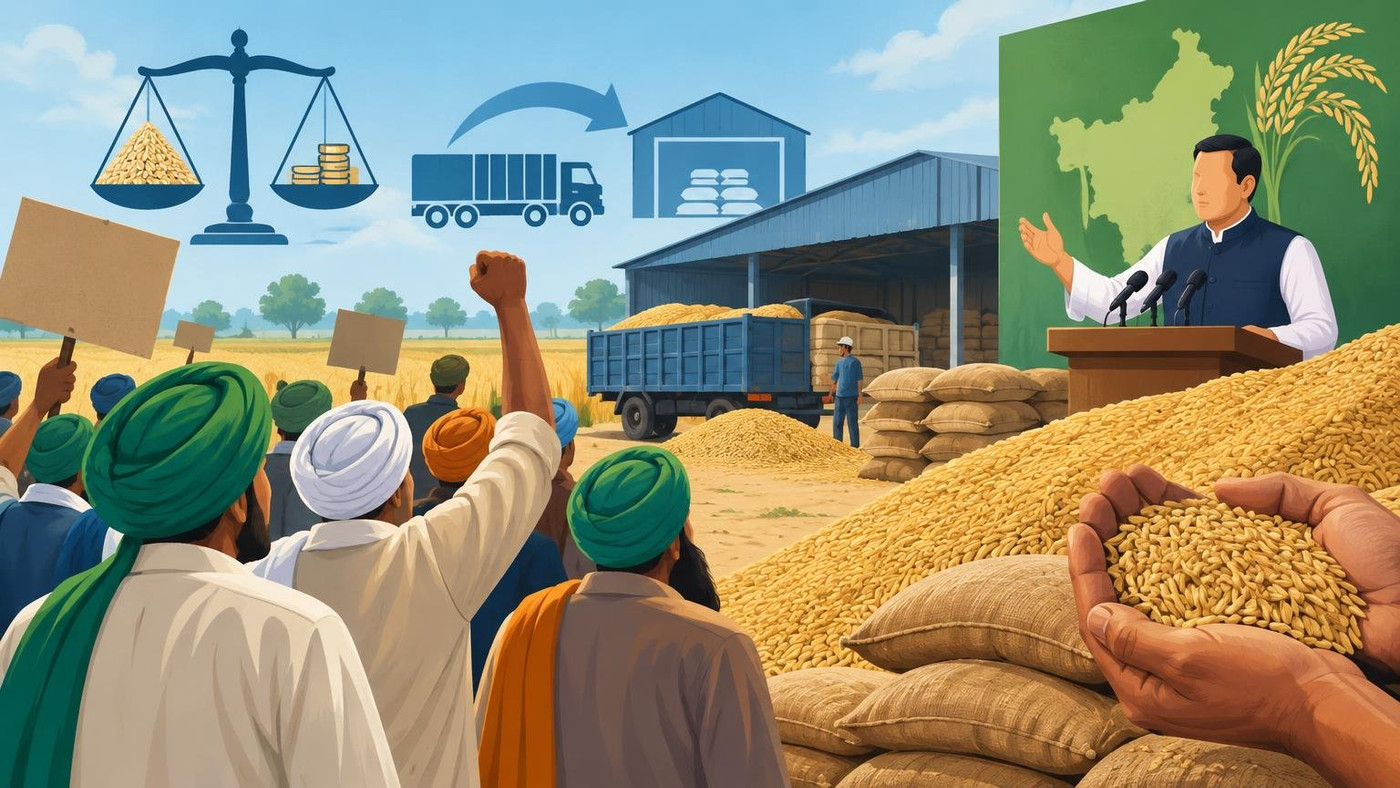
Farmers protested alleged below-MSP paddy sales in Fatehabad on Oct 9, 2026, as Haryana's minister promised to buy the entire crop at MSP and speed up lifting.
What Happened
Paddy procurement in Haryana's grain markets is running into complaints of below-support-price sales, slow lifting of grain and fertiliser shortages, weeks into the 2026-27 kharif marketing season. On Friday, October 9, 2026, a faction of the Bharatiya Kisan Union staged a protest at the Ratia grain market in Fatehabad district, alleging that Parmal paddy was being bought for Rs 1,900 to Rs 2,200 a quintal, below the minimum support price (MSP) of Rs 2,461 for Grade A paddy. The local market committee said procurement was following the rules. State Agriculture Minister Shyam Singh Rana, reviewing procurement in Ambala district, said the government would buy farmers' entire crop and pay them at MSP, and that officials across the state had been told to speed up lifting.
Key Facts
- The Centre's MSP for the 2026-27 kharif season is Rs 2,441 a quintal for common paddy and Rs 2,461 for Grade A paddy.
- At Ratia in Fatehabad, the Bharatiya Kisan Union (Kheti Bachao) protested on October 9 against alleged below-MSP purchases and black marketing of DAP fertiliser.
- Union state president Rajvinder Chahal said Parmal paddy was fetching Rs 1,900 to Rs 2,200 a quintal; the market committee secretary said procurement was proceeding as per the rules.
- At the Mullana grain market in Ambala, the market committee reported arrivals of 5.80 lakh quintals, of which 3.63 lakh quintals had been procured and 70,000 quintals lifted.
- Chief Minister Nayab Singh Saini on October 7 directed officials to speed up the lifting of paddy and bajra and to visit mandis; an officer has been posted at each mandi to oversee procurement.
- The state's agriculture department has attributed some of the waiting at mandis to paddy with moisture above the permitted 17%.
- In Sirsa district, farmers have reported delays in procurement and a shortage of DAP fertiliser ahead of rabi sowing.
Why It Matters
Haryana is one of the main states that sells paddy to the central pool, and the weeks after harvest decide a farm family's income for the season. When procurement is slow, farmers face a hard choice: wait in the mandi, sometimes for days, or sell to private traders below the support price. The gap claimed at Ratia, up to Rs 561 a quintal below MSP, would wipe out a large part of a small farmer's margin.
Lifting is the bottleneck that many of the complaints point to. Grain that has been bought but not moved out of the mandi blocks space for fresh arrivals, and delays the paperwork that triggers payment. In Mullana, less than a fifth of the paddy that had been procured had been lifted, according to the market committee's figures. The government says it has told officials to move faster, and the Chief Minister has posted an officer at each mandi to supervise.
Moisture is the other sticking point. Official procurement accepts paddy only up to 17% moisture. Grain that comes in wetter is either turned away or dried in the mandi, which adds days. Officials say this explains much of the crowding; farmer unions argue that delays and price cuts go beyond moisture.
Fertiliser adds pressure. The same farmers who are selling paddy now need DAP for wheat and other rabi crops. Reports of DAP shortages and black marketing in Fatehabad and Sirsa mean that delayed payments and costly fertiliser could hit at the same time.
| Item | Figure |
|---|---|
| MSP, common paddy (2026-27) | Rs 2,441 per quintal |
| MSP, Grade A paddy (2026-27) | Rs 2,461 per quintal |
| Price alleged at Ratia for Parmal paddy | Rs 1,900 to Rs 2,200 per quintal |
| Mullana arrivals, procured, lifted | 5.80 lakh, 3.63 lakh, 0.70 lakh quintals |
Impact
Short-term: Farmers in affected mandis may face longer waits and pressure to sell below MSP until lifting speeds up. Rice millers and procurement agencies face closer scrutiny from officials and unions.
Long-term: Repeated procurement trouble weakens trust in the MSP system and strengthens calls for faster, more transparent mandi operations, including better drying and storage, and timely fertiliser supply.
Who is affected: Paddy farmers in Haryana, especially small growers who cannot afford to wait; arhtiyas (commission agents) and rice millers; and state procurement agencies.
Key Takeaway
Haryana promises to buy all paddy at MSP, but farmers in several districts say slow lifting, moisture rules and fertiliser shortages are pushing some sales below the support price.
Questions and Answers
What is the MSP for paddy in the 2026-27 season?
The Centre fixed Rs 2,441 a quintal for common paddy and Rs 2,461 a quintal for Grade A paddy.
Why are farmers in Haryana waiting at mandis?
Farmers and unions blame slow lifting of procured grain and portal problems; state officials say much of the paddy arriving has moisture above the 17% limit, which delays official purchase.
What has the Haryana government promised?
Agriculture Minister Shyam Singh Rana said the state would buy farmers' entire crop at MSP and has told officials to speed up lifting, while the Chief Minister has posted an officer at each mandi to oversee procurement.
What can a farmer do if offered less than MSP?
A farmer can wait for official procurement once the paddy meets quality norms such as the moisture limit, and can raise a complaint with the local market committee, which oversees purchases in the mandi.
Sourced and fact-checked by the Peepals Global Editorial Team
Cold-pressed oil brand Gramiyaa raises Rs 18.65 crore at Rs 110 crore valuation
Wall Street ends volatile week higher; HCLTech and CPI data next for India
Reported, fact-checked and published by the Peepals Global Editorial Team.
Advertisement