
Centre and states meet in Delhi on Anganwadi reform, child protection and women's safety
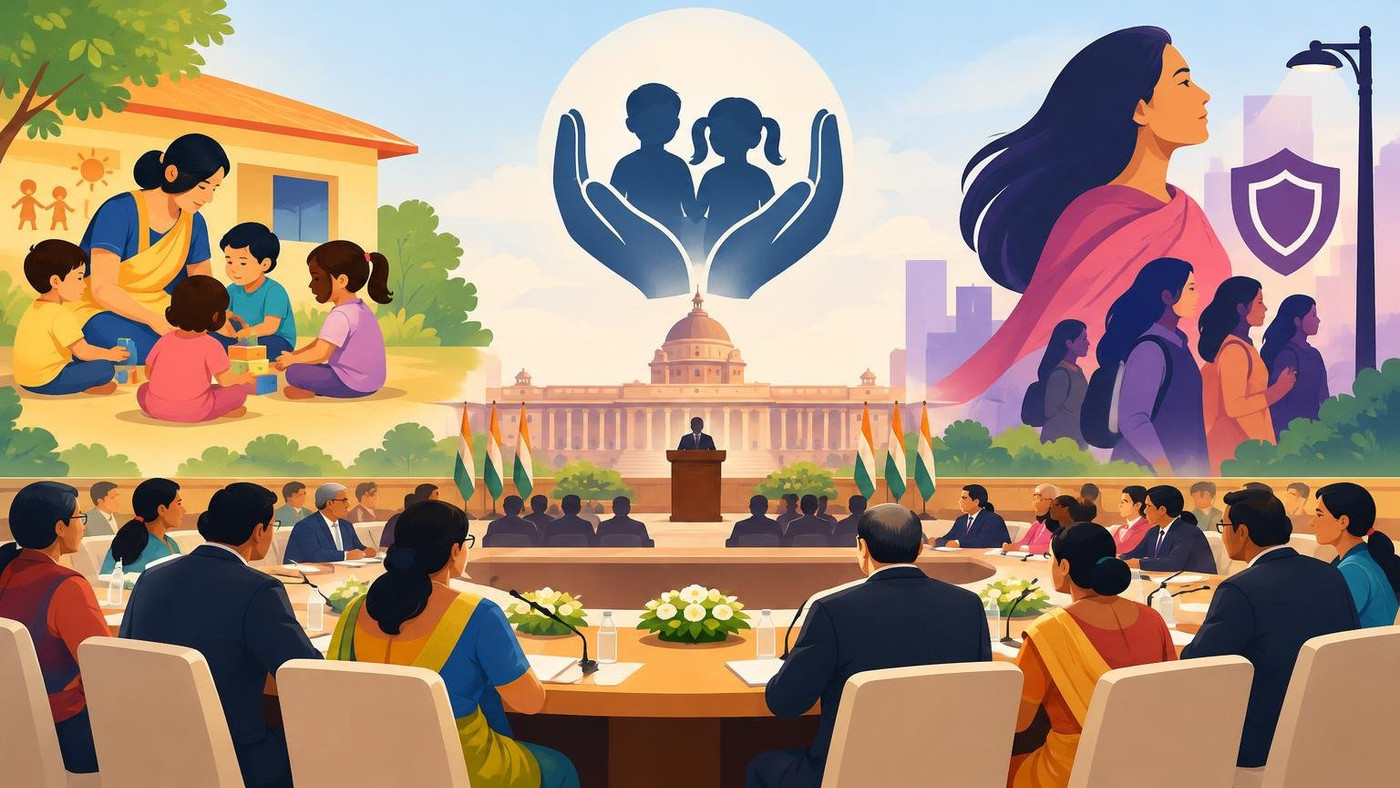
AI-generated illustration
Advertisement
A two-day Women and Child Development summit of the Centre and states ended in New Delhi on October 9, 2026, with the Prime Minister due at its closing session.
What Happened
The Union Ministry of Women and Child Development held a two-day Departmental Summit with the states and Union Territories at Sushma Swaraj Bhawan in New Delhi on Thursday, October 8, and Friday, October 9, 2026. Union Minister Annapurna Devi chaired the meeting, with Minister of State Savitri Thakur present, and ministers and senior officials from the states took part. The talks covered four areas: rethinking Anganwadi centres for nutrition and early learning, protecting vulnerable children, keeping women safe through laws and institutions, and getting better results from women's empowerment schemes. According to the Prime Minister's Office, Prime Minister Narendra Modi was to join the closing session at about 4.30 pm on October 9, where the summit's main outcomes and action plans were to be put before him.
Key Facts
- The summit ran on October 8 and 9, 2026, at Sushma Swaraj Bhawan, New Delhi.
- It is the second in a series of Departmental Summits that the Prime Minister proposed to improve working ties between the Centre and the states.
- Its four themes were Anganwadi centres, child protection, women's safety and women's empowerment schemes.
- Ministers from several states attended, including Odisha Deputy Chief Minister Pravati Parida and Arunachal Pradesh's women and child development minister Dasanglu Pul.
- The stated aim is a "Suposhit, Surakshit and Sashakt Bharat" (a well-nourished, safe and empowered India) as a base for the Viksit Bharat 2047 goal.
- The outcomes were to be presented to the Prime Minister at the closing session, with his guidance expected to set a timetable for follow-up action.
Why It Matters
For most Indian families, the women and child development ministry is felt through a few local services: the Anganwadi worker who weighs a baby, the take-home ration for a pregnant mother, the pre-school corner in the village, and, when things go wrong, the child welfare committee or the one-stop centre for women. These services are paid for largely by the Centre but run by the states. That split is why a joint summit matters. Rules set in Delhi only change a family's life if a state department, a district officer and an Anganwadi worker carry them out.
The ministry groups its schemes into three missions. Mission Saksham Anganwadi and Poshan 2.0 covers nutrition and early childhood care. Mission Shakti covers the safety, protection and empowerment of women. Mission Vatsalya covers children in difficult circumstances, such as orphans, abandoned children and those in conflict with the law. The summit's four themes map closely onto these three missions, which suggests the aim is to tighten delivery of existing schemes rather than to launch new ones.
The focus on Anganwadi centres as places of early learning, and not only of food, reflects a wider shift. Parents increasingly expect the first years of a child's life to include play-based learning, language and basic numbers, not just a meal. For working mothers, a well-run Anganwadi can also be a reliable place to leave a young child for part of the day.
| | Mission | What it covers | Where families meet it | |
|---|---|---|
| | Saksham Anganwadi and Poshan 2.0 | Nutrition, early childhood care and education | Local Anganwadi centre | |
| | Mission Shakti | Women's safety, protection and empowerment | Helplines, one-stop centres | |
| | Mission Vatsalya | Care of vulnerable children | Child welfare committees, foster and adoption services | |
Impact
Short-term: States are expected to take home action points from the summit and report back on them. Families are unlikely to see changes at once, as most steps will need state orders and budgets.
Long-term: If the action plans are followed, parents could see better-equipped Anganwadi centres with more focus on early learning, and faster help for children and women in distress.
Who is affected: Pregnant and nursing mothers, children under six, adolescent girls, children in need of care and protection, Anganwadi workers and helpers, and state women and child development departments.
Key Takeaway
The Centre and the states used a two-day summit to align on how Anganwadis, child protection and women's safety services should work on the ground, with follow-up to be set after the Prime Minister's closing session.
Questions and Answers
When and where was the women and child development summit held?
It was held on October 8 and 9, 2026, at Sushma Swaraj Bhawan in New Delhi, organised by the Union Ministry of Women and Child Development with the states and Union Territories.
What topics did the summit cover?
Four themes: improving Anganwadi centres for nutrition and early education, protecting vulnerable children, women's safety through laws and institutions, and better results from women's empowerment schemes.
Will this change anything at my local Anganwadi right away?
Not immediately. The summit produces action plans; changes on the ground depend on state governments issuing orders and funding them in the months ahead.
Which national schemes are linked to these themes?
Mission Saksham Anganwadi and Poshan 2.0 for nutrition and early childhood care, Mission Shakti for women's safety and empowerment, and Mission Vatsalya for the care and protection of children.
Sourced and fact-checked by the Peepals Global Editorial Team
India's apparel market to reach $146.3 billion by 2029, rural India leads spending
International Day of the Girl Child 2026: Where Girls' Rights Stand in India
Reported, fact-checked and published by the Peepals Global Editorial Team.
Advertisement