
International Day of the Girl Child 2026: Where Girls' Rights Stand in India
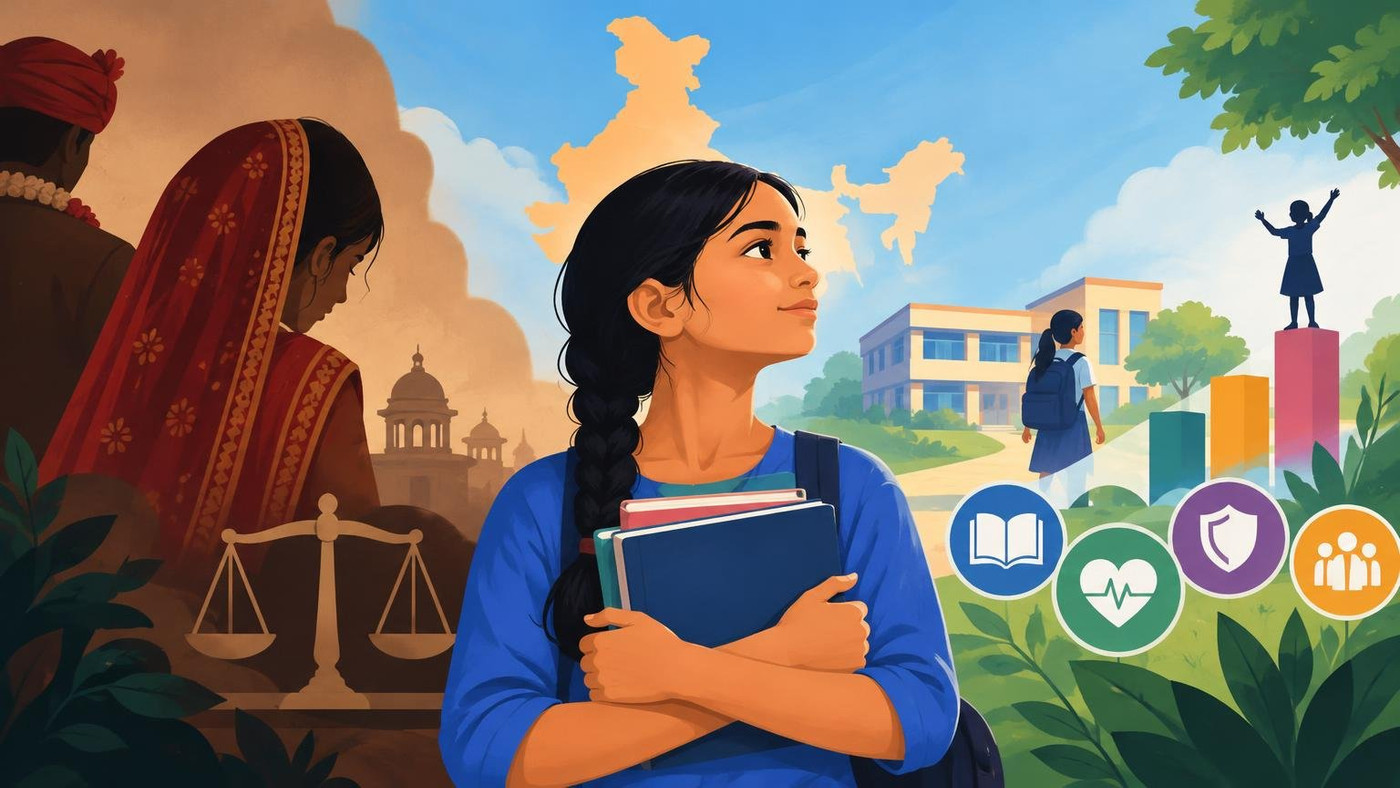
AI-generated illustration
Advertisement
As International Day of the Girl is observed on 11 October 2026 with a focus on child marriage, India's own campaign and survey data show progress and gaps.
What Happened
International Day of the Girl Child will be observed on Sunday, 11 October 2026, with the United Nations theme "End child marriage and invest in girls' rights". The UN General Assembly adopted Resolution 66/170 on 19 December 2011 to create the day, which was first observed in 2012. For India, the theme points to a long-running policy effort. India has halved child marriage over fifteen years, but progress has slowed.
Key Facts
- The UN General Assembly adopted Resolution 66/170 on 19 December 2011, declaring 11 October the International Day of the Girl Child. The day was first observed in 2012.
- UNICEF estimates that one in five girls worldwide is married before 18, which adds up to about 650 million women and girls alive today.
- The National Family Health Survey (NFHS) shows child marriage among women aged 20 to 24 fell from 47.4 per cent in 2005-06 to 26.8 per cent in 2015-16.
- NFHS-5 for 2019-21 recorded 23.3 per cent of women aged 20 to 24 as married before 18, a fall of only 3.5 percentage points in five years.
- NFHS-5 shows the highest rates in West Bengal at 42 per cent and Bihar at 40 per cent. The lowest is Lakshadweep at 4 per cent, followed by Jammu and Kashmir and Ladakh at 6 per cent each.
- The Prohibition of Child Marriage Act, 2006 defines a child as a female under 18 or a male under 21. Penalties include imprisonment and fines up to Rs 1 lakh for adult men who marry children and for those who abet such marriages.
- On 18 October 2024, the Supreme Court ruled in Society for Enlightenment and Voluntary Action vs Union of India, issuing directions to strengthen prevention across the country and prohibiting child betrothals.
- The Ministry of Women and Child Development launched the Bal Vivah Mukt Bharat campaign on 27 November 2024. It aims to cut prevalence by 10 per cent by 2026 and make India child marriage-free by 2030.
Why It Matters
The global numbers explain the focus on child marriage. UNICEF says one in five girls worldwide is married before 18, and campaigners cite UNICEF data indicating around 12 million girls are still married each year. The UN is calling on governments to enforce 18 as the minimum marriage age and to fund programmes that change social norms.
India is central to that picture. UNICEF estimates, as cited in Indian policy explainers, say India accounts for nearly one-third of the world's women married as children. At the same time, India has cut its own rate sharply, which shows that sustained policy can change outcomes for girls.
The trend, however, is slowing. The table below shows the NFHS figures for women aged 20 to 24 married before 18.
| Survey round | Share married before 18 |
|---|---|
| NFHS 2005-06 | 47.4% |
| NFHS 2015-16 | 26.8% |
| NFHS-5 2019-21 | 23.3% |
The fall of 20.6 points in the first decade gave way to 3.5 points in the next five years. The Press Information Bureau (PIB), the government's information agency, cites the same NFHS-5 figure of 23 per cent in its backgrounder.
The national figure also hides wide gaps between states. West Bengal, Bihar, Tripura, Jharkhand, Andhra Pradesh and Assam record 32 to 42 per cent. Himachal Pradesh, Goa and Nagaland are at 7 per cent each. The Ministry of Women and Child Development has used NFHS-5 data to prioritise 257 high-burden districts.
The Supreme Court's October 2024 ruling moved the emphasis from punishing offenders after the fact to preventing marriages before they happen. The court noted that child betrothals weaken personal autonomy and often lead to forced marriages. The ruling now guides how states enforce the law.
Impact
Short-term: The UN theme gives the 11 October 2026 observance a clear focus on child marriage. In India, early campaign figures are modest but concrete. As of December, 54,917 Child Marriage Prohibition Officers had been appointed nationwide, according to a summary of the campaign's first year. The same summary says 1,520 child marriages were prevented in that year, with Madhya Pradesh and Haryana reporting the highest numbers. Balod district in Chhattisgarh became India's first child marriage-free district in 2025, according to PIB.
Long-term: On 4 September 2026, the 193-member UN General Assembly adopted by consensus a resolution tabled by Sierra Leone. It creates an annual international observance on ending child, early and forced marriage, set for 27 November, the anniversary of India's campaign launch. The observance will give the Indian campaign a yearly international platform from November.
Who is affected: Schools and families are also involved. Policy analyses citing NFHS-5 point to Samagra Shiksha and the National Scheme of Incentive to Girls for Secondary Education, which help keep girls in school. Some villages have declared "no child marriage" zones. Rise Up Together, a non-profit, reports that a youth leader in Jharkhand helped build momentum for a Child Protection Policy that could cover about six million children across 44,835 schools.
Key Takeaway
India cut child marriage from 47.4 per cent to 23.3 per cent between 2005-06 and 2019-21, but the slowing pace and state gaps explain the push towards 2030.
Questions and Answers
When is International Day of the Girl 2026?
International Day of the Girl Child will be observed on Sunday, 11 October 2026. The UN theme is "End child marriage and invest in girls' rights". The day was first observed in 2012.
What is India's child marriage rate?
NFHS-5 for 2019-21 recorded 23.3 per cent of women aged 20 to 24 as married before 18. This is down from 47.4 per cent in 2005-06 and 26.8 per cent in 2015-16.
What is the Bal Vivah Mukt Bharat campaign?
Bal Vivah Mukt Bharat is a campaign launched by the Ministry of Women and Child Development on 27 November 2024. It aims to cut child marriage prevalence by 10 per cent by 2026 and make India child marriage-free by 2030.
Which states have the highest child marriage rates in India?
NFHS-5 data show West Bengal at 42 per cent, Bihar at 40 per cent, Tripura at 39 per cent, Jharkhand at 35 per cent, Andhra Pradesh at 33 per cent and Assam at 32 per cent.
Reviewed & Edited by Prashant Sonar
Reviewed & Edited by Prashant Sonar. Published by the Peepals Global Editorial Team.
Advertisement