
Airtel pitches sovereign cloud and AI security at IMC, says data location isn't enough
AI-generated illustration
Advertisement
Airtel showcased sovereign cloud and AI security used by Indian Railways and EPFO to minister Scindia at IMC 2026 on Oct 8, 2026, and said data residency is not sovereignty.
What Happened
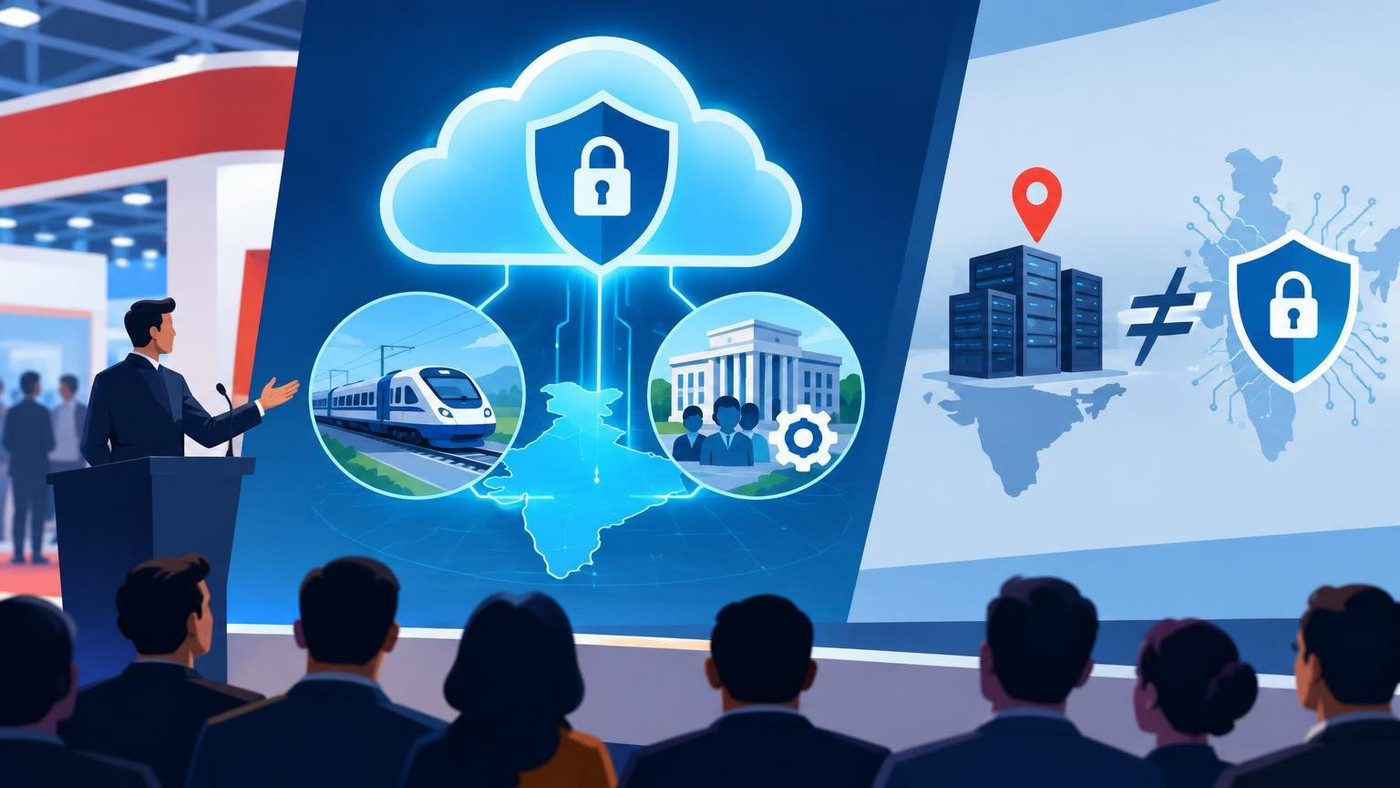
Bharti Airtel used the India Mobile Congress 2026 in New Delhi to pitch its sovereign cloud, data centre and AI-driven cybersecurity services to businesses and government, showcasing them to Communications Minister Jyotiraditya Scindia on Thursday, October 8, 2026. Chairman Sunil Bharti Mittal briefed the minister at the company's stand. Airtel presented Airtel Cloud as a way for enterprises to meet data residency requirements on an Indian stack, and said its AI-powered security operations centre, iSOC, is already in use by select customers including Indian Railways and the Employees' Provident Fund Organisation (EPFO). At a panel during the event, an Airtel executive argued that keeping data in India is not, on its own, enough to make it sovereign.
Key Facts
- Airtel showcased its cloud, data centre, cybersecurity and quantum research work to Communications Minister Jyotiraditya Scindia at IMC 2026 on October 8, 2026.
- Airtel Cloud is offered with multiple availability zones and pitched as a way for enterprises to meet data residency rules.
- The company frames the service as bringing connectivity, cloud and data centres together on a sovereign Indian stack.
- Airtel's AI-powered iSOC is deployed for select customers, including Indian Railways and EPFO; Mittal described it as offering layered protection with round-the-clock managed defence and automated response.
- Airtel highlighted research at IIT Delhi's Bharti School of Telecommunication Technology and Management on quantum-based optimisation of telecom networks.
- Chief Business Officer Abhishek Biswal said at a panel that storing data in India does not by itself make it sovereign.
- India Mobile Congress 2026 runs in New Delhi from October 7 to 10.
Why It Matters
"Sovereign cloud" has become one of the biggest selling points in enterprise technology. Banks, insurers, government departments and companies holding citizens' data face rules that require certain data to stay in India. Global cloud providers have built Indian data centres to meet these rules, and Indian players such as Airtel are now competing by arguing that a domestic provider offers more control.
Airtel's own executive made a sharper point: location is not the same as sovereignty. If data sits in India but the software, encryption keys or management of the system are controlled from abroad, a foreign government or company could still have access. That argument goes beyond what most Indian rules require today, which focus mainly on where data is stored. It is also, naturally, an argument that favours Indian providers.
For businesses deciding where to put sensitive workloads, the debate matters in practical terms. Questions to ask any provider include who holds the encryption keys, where the systems are operated from, and which country's laws could compel access. The answers affect compliance risk, especially for regulated sectors.
The security deployments are also significant. When large public bodies such as Indian Railways and EPFO rely on an operator-run security centre, it shows a shift toward buying cybersecurity as a managed service, bundled with connectivity, rather than building it all in-house. That model could spread to mid-sized firms that cannot afford their own round-the-clock security teams.
| Offering | What Airtel says it provides |
|---|---|
| Airtel Cloud | Multi-zone cloud on an Indian stack to meet data residency needs |
| iSOC | AI-powered managed security, used by Indian Railways and EPFO |
| Quantum research | Work with IIT Delhi on quantum optimisation for telecom networks |
Impact
Short-term: Enterprises and government buyers evaluating cloud and security providers will hear more "sovereign" pitches from Indian telecom and cloud companies, and should test those claims on control and access, not only location.
Long-term: If India's rules move from data location toward control and access, domestic providers could gain ground in regulated sectors, and global providers may adapt by offering more locally controlled services.
Who is affected: Banks, insurers, government departments and other organisations handling sensitive data; cloud and cybersecurity providers; and policymakers shaping India's data protection and localisation rules.
Key Takeaway
At IMC 2026, Airtel pitched sovereign cloud and AI-run security to government and enterprise buyers, arguing that true data sovereignty depends on control, not just on keeping data in India.
Questions and Answers
What is a sovereign cloud?
It is a cloud service designed so that data, operations and control stay under a country's own jurisdiction. Airtel says its cloud runs on an Indian stack to meet data residency requirements.
Is storing data in India the same as data sovereignty?
Not necessarily. An Airtel executive argued at IMC 2026 that if software, keys or operations are controlled from abroad, data stored in India may still not be fully under Indian control.
Who uses Airtel's iSOC security service?
Airtel says its AI-powered iSOC is deployed for select customers, including Indian Railways and the Employees' Provident Fund Organisation.
When and where was this showcased?
At India Mobile Congress 2026 in New Delhi, where Airtel presented it to Communications Minister Jyotiraditya Scindia on October 8, 2026.
Sourced and fact-checked by the Peepals Global Editorial Team
Indian start-up funding drops sharply in early October as big rounds vanish
Ola Electric sets Rs 1,000 crore rights issue at Rs 27, a 26% discount
Reported, fact-checked and published by the Peepals Global Editorial Team.
Advertisement