
India's Weak Monsoon Puts Agriculture Under Strain: Drought, Rabi Risks and Rural Demand
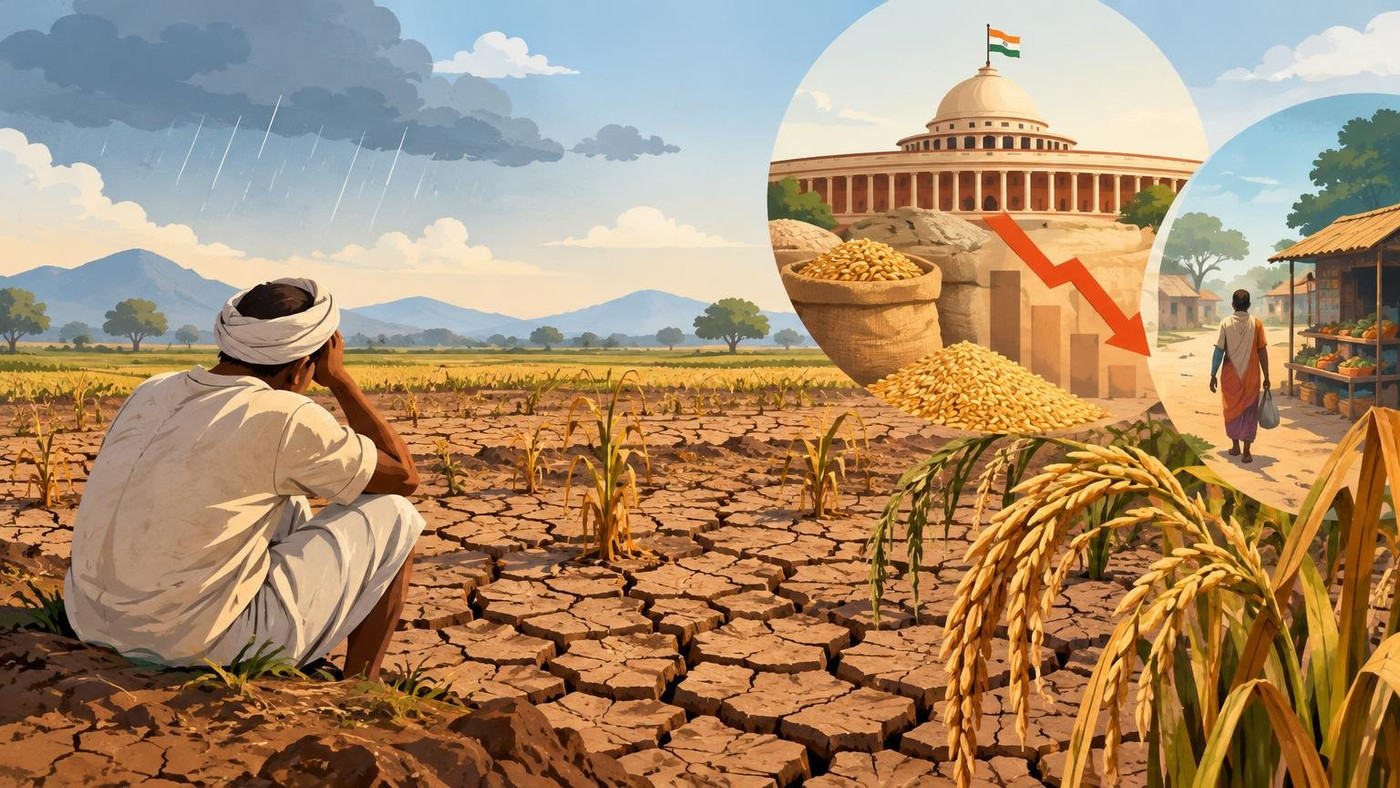
AI-generated illustration
Advertisement
India's weakest monsoon since 2015 has led states to declare drought and the Centre to cut its 2026-27 foodgrain target, raising risks for farm incomes and rural demand.
What Happened
India's agriculture sector is under strain after the weakest monsoon since 2015. Karnataka and Maharashtra have declared drought in large parts of their territory. The Union agriculture ministry has lowered its 2026-27 foodgrain target to 373.93 million tonnes. The figures come from reports published between 1 and 10 October 2026, and central teams are now assessing the situation in both states.
Key Facts
- The India Drought Monitor, run by IIT Gandhinagar, showed 70.6 per cent of India's land area under dry or drought conditions in the week of its latest report.
- Union Agriculture Minister Shivraj Singh Chouhan put the national monsoon rainfall deficit at about 12 per cent, which is moderate compared with past drought years.
- Karnataka has classified 217 of its 240 taluks as drought-affected. Crop-loss assessment for the first 177 taluks showed damage across 47.09 lakh hectares and an estimated loss of ₹46,324.5 crore.
- Maharashtra has declared drought in 265 of its 358 tehsils, about 74 per cent of the state's sub-districts, after an 18 per cent statewide rainfall deficit.
- Around 42.68 million hectares had been sown under paddy, nearly 1.7 million hectares less than at the same time last year.
- Tractor sales at Mahindra & Mahindra fell 21 per cent in September 2026, and Escorts Kubota's fell 16.7 per cent, according to data published on 1 October.
- Household demand for work under the VB-G RAM G scheme rose 34 per cent to 15.64 million in September, up 26 per cent from August.
- Agriculture and allied activities employ 46.1 per cent of India's workforce and contribute 15.2 per cent of nominal GDP, according to the Economic Survey 2025-26.
Why It Matters
The headline rainfall number understates the problem. A deficit of about 12 per cent is smaller than the 19 per cent shortfalls of 1987 and 2002, and the 14 per cent of 2015. This year the damage comes from distribution: dry spells during critical crop stages have hit rain-dependent regions hard, even where the seasonal total looks closer to normal.
| Year | Monsoon rainfall deficit |
|---|---|
| 1987 | 19% |
| 2002 | 19% |
| 2015 | 14% |
| 2026 (Chouhan's estimate) | about 12% |
Farm incomes can fall by more than output. An analysis by Sustainability Matters India estimates that a 20 per cent production loss can mean a 67 per cent fall in cultivation income, because costs stay fixed. It estimates about one crore households may be exposed, roughly 11 to 12 per cent of India's 9.3 crore agricultural households. This is an estimate, not a count of confirmed losses.
The rabi season, sown mainly from October, is the next test. Wheat is the key crop, with a government target of 121 million tonnes. Uttar Pradesh, Madhya Pradesh, Punjab, Haryana and Rajasthan together account for roughly three-quarters of wheat output, so water availability there matters for national food security.
Water is a concern. Wheat generally needs four to six irrigations, and the first is due within about 21 to 25 days of sowing. Reservoir levels in parts of northern India were below last year's. Most of Punjab's 153 development blocks are classified as over-exploited for groundwater, according to a 6 October analysis.
Chouhan has played down the risk. He said there is a problem in some areas but no major crisis, and he expressed optimism about the kharif harvest and fertiliser supply. India entered the rabi season with fertiliser stocks at their highest level in two years, according to a 2 October report. Yet India imports an estimated 80 to 90 per cent of its phosphoric acid and finished DAP needs, and international DAP prices remained elevated in 2026.
Impact
Short-term: Rural spending is already weakening. Tractor sales fell sharply in September, while passenger vehicle demand stayed strong ahead of the festive season, so the weakness is concentrated in farm-linked spending. Demand for rural jobs under the VB-G RAM G scheme has risen, which usually signals that farm earnings are falling short. A central team reached Bengaluru on 3 October 2026, and a separate team is being sent to Maharashtra. Both states have sought help from the Centre.
Long-term: The government is steering farmers towards less water-intensive crops. Chouhan said the Khet Bachao Abhiyan will run nationwide from 22 October to 30 November 2026, focusing on soil health, scientific support and crop diversification. It encourages pulses in areas left fallow after paddy, and district-level rabi plans are being drawn up based on water availability. Dairy could also feel the effect: lower milk output from uneven rains and costlier fodder could keep milk prices high in the coming flush season.
Who is affected: Farm households in Karnataka and Maharashtra are the most directly exposed, along with rain-dependent regions where dry spells hit key crop stages. Paddy growers have seen the largest acreage drop. Wheat farmers in Uttar Pradesh, Madhya Pradesh, Punjab, Haryana and Rajasthan depend on water for the rabi season. Tractor makers such as Mahindra & Mahindra and Escorts Kubota face weaker sales. Because agriculture employs 46.1 per cent of the workforce, the effects can spread to rural wages and demand.
Key Takeaway
India's weakest monsoon since 2015 has led to drought declarations in two states, a lower foodgrain target and weaker rural demand, and the rabi sowing and central assessments are the next markers.
Questions and Answers
How weak is India's 2026 monsoon?
It is India's weakest monsoon since 2015. Agriculture Minister Shivraj Singh Chouhan put the national rainfall deficit at about 12 per cent, but dry spells at critical crop stages hit rain-dependent regions hard.
Which states have declared drought in 2026?
Karnataka has classified 217 of its 240 taluks as drought-affected. Maharashtra has declared drought in 265 of its 358 tehsils, about 74 per cent of its sub-districts. Both have sought help from the Centre.
What is India's 2026-27 foodgrain target?
The Union agriculture ministry has lowered its 2026-27 foodgrain target to 373.93 million tonnes. Within it, the rabi foodgrain target is 177.72 million tonnes, and the wheat target is 121 million tonnes.
How is the weak monsoon affecting rural demand?
Tractor sales at Mahindra & Mahindra fell 21 per cent in September 2026 and at Escorts Kubota 16.7 per cent. Demand for work under the VB-G RAM G scheme rose 34 per cent to 15.64 million.
Reviewed & Edited by Prashant Sonar
Reviewed & Edited by Prashant Sonar. Published by the Peepals Global Editorial Team.
Advertisement