
Vice-President urges Sanskrit scholars to edit and publish unpublished manuscripts
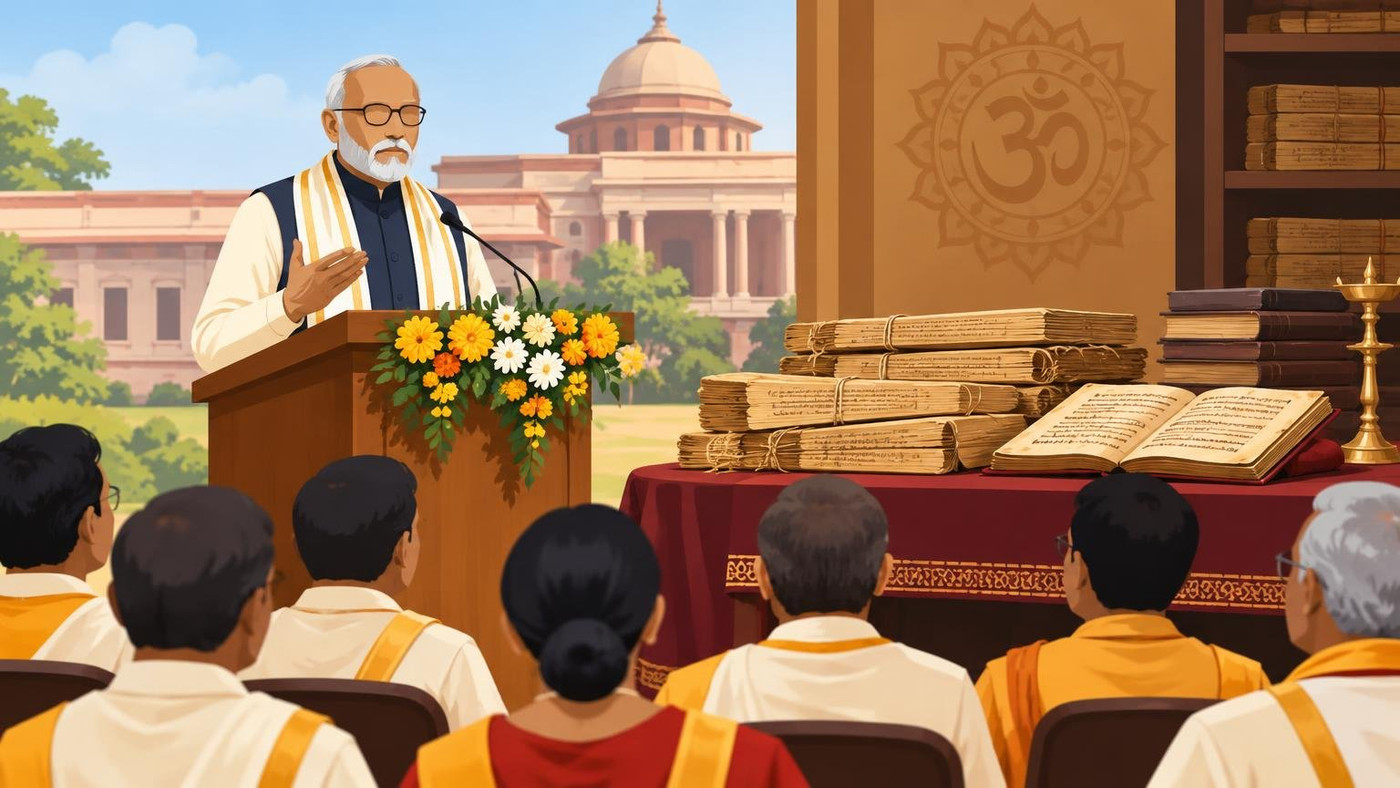
AI-generated representative image
Advertisement
At a Sanskrit university convocation in Delhi on 6 October 2026, Vice-President C. P. Radhakrishnan urged scholars to edit and publish unpublished manuscripts.
What Happened
Vice-President C. P. Radhakrishnan called on scholars at Shri Lal Bahadur Shastri National Sanskrit University to find, preserve, critically edit and publish Sanskrit manuscripts that have never been printed, speaking at the university's second convocation in New Delhi on Tuesday, 6 October 2026. He said India's ancient knowledge should not stay locked away in manuscripts and libraries, and urged the central university, whose Vice-Chancellor is Professor Murli Manohar Pathak, to grow into a leading international centre of excellence for Sanskrit studies. Union Minister of State for Education Sukanta Majumdar also attended. The Vice-President presented gold medals to top graduates.
Key Facts
- Event: second convocation of Shri Lal Bahadur Shastri National Sanskrit University, New Delhi, 6 October 2026.
- Chief guest: Vice-President C. P. Radhakrishnan; also present: Minister of State for Education Sukanta Majumdar and Vice-Chancellor Prof. Murli Manohar Pathak.
- Main appeal: teachers and students should take up the discovery, preservation, critical editing and publication of unpublished Sanskrit manuscripts.
- He linked that work to the government's Gyan Bharatam Mission for manuscripts, which he said has a foundational corpus of Rs 500 crore.
- He described Sanskrit as the "golden string" that connects the pearls of India's many languages into one grand garland.
- He said India's ancient knowledge should reach people beyond manuscripts and libraries, and spoke of using artificial intelligence for this.
- He advised graduates to use social media wisely and not let the virtual world take them away from the real one.
Why It Matters
India's manuscript heritage is vast, and only a small part of it is open to readers. Government figures released in June 2026 put the number of manuscripts documented under the Gyan Bharatam Mission at more than 44 lakh, with about 1.29 lakh accessible to the public on the National Digital Repository. A critical edition, in which scholars compare different copies of a text, correct errors and publish a reliable version, is what turns a fragile manuscript into something that teachers, students and researchers can actually use.
That is slow, skilled work, and it needs people trained in reading old scripts and in the grammar and subject matter of the texts. Sanskrit universities are where many such scholars are trained. By putting this task at the centre of his convocation speech, the Vice-President was pointing graduates towards a field where their training is scarce and much needed.
The link to the Gyan Bharatam Mission matters too. The mission's aim is to preserve, digitise and share India's manuscript heritage. Digitising a page preserves it, but someone still has to read, interpret and edit it before its knowledge enters modern learning. The Vice-President's call connects the mission's digital work with the scholarship needed to make sense of what is being saved.
His remarks on AI and social media show the balance he was asking for: using modern tools to spread old knowledge, while warning young people not to lose themselves in screens.
| Point | What the Vice-President said |
|---|---|
| Manuscripts | Discover, preserve, critically edit and publish unpublished Sanskrit texts |
| Ancient knowledge | Should not remain confined to manuscripts and libraries |
| Sanskrit | The "golden string" linking India's many languages |
| University's goal | Become a leading international centre of excellence for Sanskrit |
| Youth advice | Use social media wisely, stay connected to the real world |
Impact
Short-term: The speech gives the university's new graduates, and Sanskrit departments elsewhere, a clear public priority: editing and publishing unpublished manuscripts.
Long-term: If universities and the Gyan Bharatam Mission work together, more of India's manuscript heritage could become available as reliable printed and digital editions for research and teaching.
Who is affected: Sanskrit scholars and students, manuscript libraries and their custodians, researchers in Indian knowledge systems, and institutions taking part in the Gyan Bharatam Mission.
Key Takeaway
At a Sanskrit university convocation on 6 October 2026, the Vice-President urged scholars to edit and publish India's unpublished Sanskrit manuscripts so their knowledge reaches people beyond libraries.
Questions and Answers
What did the Vice-President ask Sanskrit scholars to do?
He urged teachers and students of Shri Lal Bahadur Shastri National Sanskrit University to discover, preserve, critically edit and publish unpublished Sanskrit manuscripts.
When and where did he speak?
At the university's second convocation in New Delhi on Tuesday, 6 October 2026, with Minister of State for Education Sukanta Majumdar also present.
What is a critical edition of a manuscript?
It is a reliable printed version of a text, prepared by scholars who compare different handwritten copies, correct errors and explain variations, so others can study it.
How is this linked to the Gyan Bharatam Mission?
The Vice-President tied the manuscript work to the government's Gyan Bharatam Mission for manuscripts, which he said has a foundational corpus of Rs 500 crore.
Sourced and fact-checked by the Peepals Global Editorial Team
Dibrugarh University puts 53,275 pages of Sanchipat manuscripts online for free
Jogindernagar fights move of medicinal plants centre to Solan; Ayush ministry steps in
Reported, fact-checked and published by the Peepals Global Editorial Team.
Advertisement