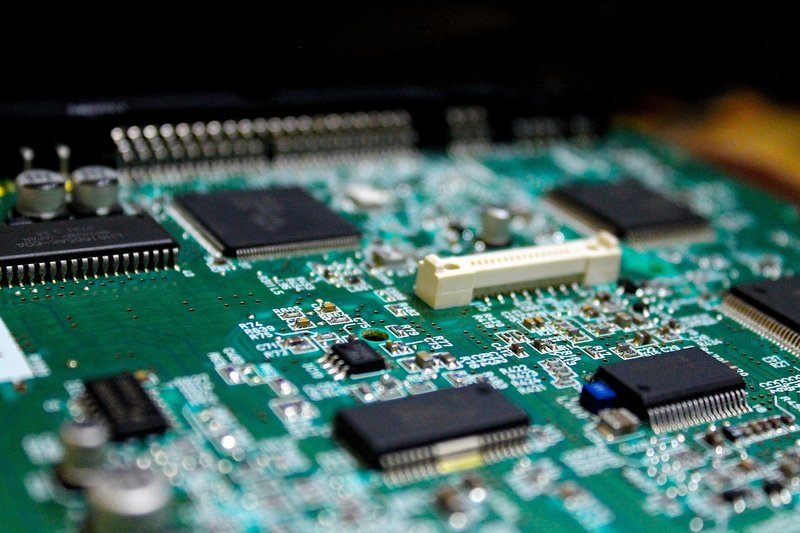

Oracle share price rises as Google's TPU AI chips come to Oracle Cloud
 By Pooja MehraIndustry Trends Analyst, Peepals Tech
Representative image: dexmac / Pixabay
Oracle said on 27 October 2026 it will rent out Google's eighth-generation TPU AI chips on its cloud from 2027, the first time another big cloud will offer them.
What Happened
Oracle's share price rose about 5% on Tuesday, 27 October 2026, after the company announced at its Oracle AI World event in Las Vegas that it will offer Google's Tensor Processing Units (TPUs), Google's own artificial-intelligence chips, on Oracle Cloud Infrastructure from 2027. It is the first time a large cloud company other than Google will rent out the chips. Google confirmed the shift a day later as part of a wider plan to sell more of its AI chips through partners.
Key Facts
- The offer covers Google's eighth-generation chips: the TPU 8t, designed for training AI models, and the TPU 8i, designed for inference, which means running trained models to answer users' requests.
- Oracle will provide power, cooling and data-centre networking, while the TPU systems keep Google's own chip-to-chip connections, according to Google.
- Capacity is expected to grow over several years; prices, regions and starting capacity have not been announced.
- In the same week Oracle also announced chips from Cerebras and SambaNova for its cloud and said it plans to offer Nvidia's Vera systems.
- Google Cloud chief executive Thomas Kurian said on Alphabet's earnings call that Google has more than 100 significant TPU customers.
- Analysts at TD Cowen have projected TPU sales of $9.4 billion in the second half of 2026 and $62.5 billion in 2027; these are analysts' estimates, not company figures.
Why It Matters
Most of the world's AI computing runs on graphics processing units (GPUs) made by Nvidia. A GPU is a chip that can do many small calculations at once, which suits the maths behind AI models. Google designed its TPUs for the same work, but until now customers could mainly use them inside Google's own cloud. By letting Oracle rent them out, Google is turning its chip from an in-house advantage into a product that competes more directly with Nvidia.
For Oracle, the deal widens what it can offer AI customers. Rather than depending on one chip supplier, Oracle Cloud Infrastructure (OCI) will carry Nvidia, Google, Cerebras and SambaNova hardware. Customers who build AI services can then choose the chip that gives them the best cost or speed for a given task. The share-price rise on 27 October showed that investors read the announcement as good news for Oracle's cloud growth, but a one-day move is not a forecast, and the TPU capacity will only start in 2027.
For Google, the change is part of what Kurian has presented as a new playbook for its cloud business: using partners to reach more customers with its chips. Kurian joined Google in 2018 after more than 20 years at Oracle. Google says its own silicon reaches payback faster than servers built on other chips; that is the company's claim and has not been independently tested.
For India, the effect is indirect. Indian companies building AI products rent most of their computing from global cloud providers, so more choice of chips and more competition among suppliers could, over time, influence the price and availability of AI computing that Indian start-ups and IT firms buy.
| Company | What it announced or said | When |
|---|---|---|
| Oracle | Google TPU 8t and 8i on OCI | Announced 27 Oct 2026, available from 2027 |
| Selling more TPUs through partners | 28 Oct 2026 | |
| Oracle | Cerebras, SambaNova chips; plans for Nvidia Vera | Week of 27 Oct 2026 |
Impact
Short-term: Nothing changes for cloud customers yet, because the TPU capacity on Oracle's cloud begins in 2027. The immediate effect was on investor sentiment around Oracle and on the wider debate about Nvidia's lead in AI chips.
Long-term: If the arrangement works, other cloud providers may face pressure to offer a wider mix of AI chips, and Google could become a larger chip seller to the industry rather than only a cloud provider.
Who is affected: AI companies and developers who rent computing power; Oracle, Google and Nvidia; and businesses in India and elsewhere that buy AI services built on these clouds.
Key Takeaway
Oracle will become the first large outside cloud to rent Google's TPU AI chips, from 2027, giving customers an alternative to Nvidia-based systems on the same platform.
Questions and Answers
Why did the Oracle share price rise on 27 October 2026?
Oracle's shares rose about 5% after the company announced at Oracle AI World that it will offer Google's TPU AI chips on Oracle Cloud Infrastructure from 2027, along with other new AI chip options.
What is a TPU?
A Tensor Processing Unit is a chip designed by Google specifically for the calculations used in artificial intelligence. Google's eighth-generation versions are the TPU 8t, for training AI models, and the TPU 8i, for running trained models.
When can customers use Google TPUs on Oracle Cloud?
From 2027, with capacity growing over several years. Oracle and Google have not yet announced prices, regions or how much capacity will be available at the start.
Does this mean Oracle is dropping Nvidia?
No. Oracle said it also plans to offer Nvidia's Vera systems and has added chips from Cerebras and SambaNova, so Google's TPUs will sit alongside other suppliers rather than replace them.
Disclaimer: Prepared by the Peepals newsroom from publicly available sources with AI assistance. Information is accurate to the best of our knowledge at the time of publication and may change. Images may be representative. Not professional advice. Report an error via our contact page.
By Pooja Mehra, Industry Trends AnalystCovers Industry News & Trends and more for Peepals Tech. All stories by Pooja Mehra
Sridhar Vembu: one person with AI can do the work of 10
Drupal Commerce flaw exploited against online stores; patch urged now
Get the day's stories in your inbox
Peepals Weekly: the week decoded, free. One email a week, unsubscribe in one click.
Pooja Mehra is a pen name of the Peepals Global Editorial Team, which researches, fact-checks and publishes every story. The portrait is an illustration.