
Gyan Bharatam Mission Uses AI to Digitise India's Manuscripts and Heritage
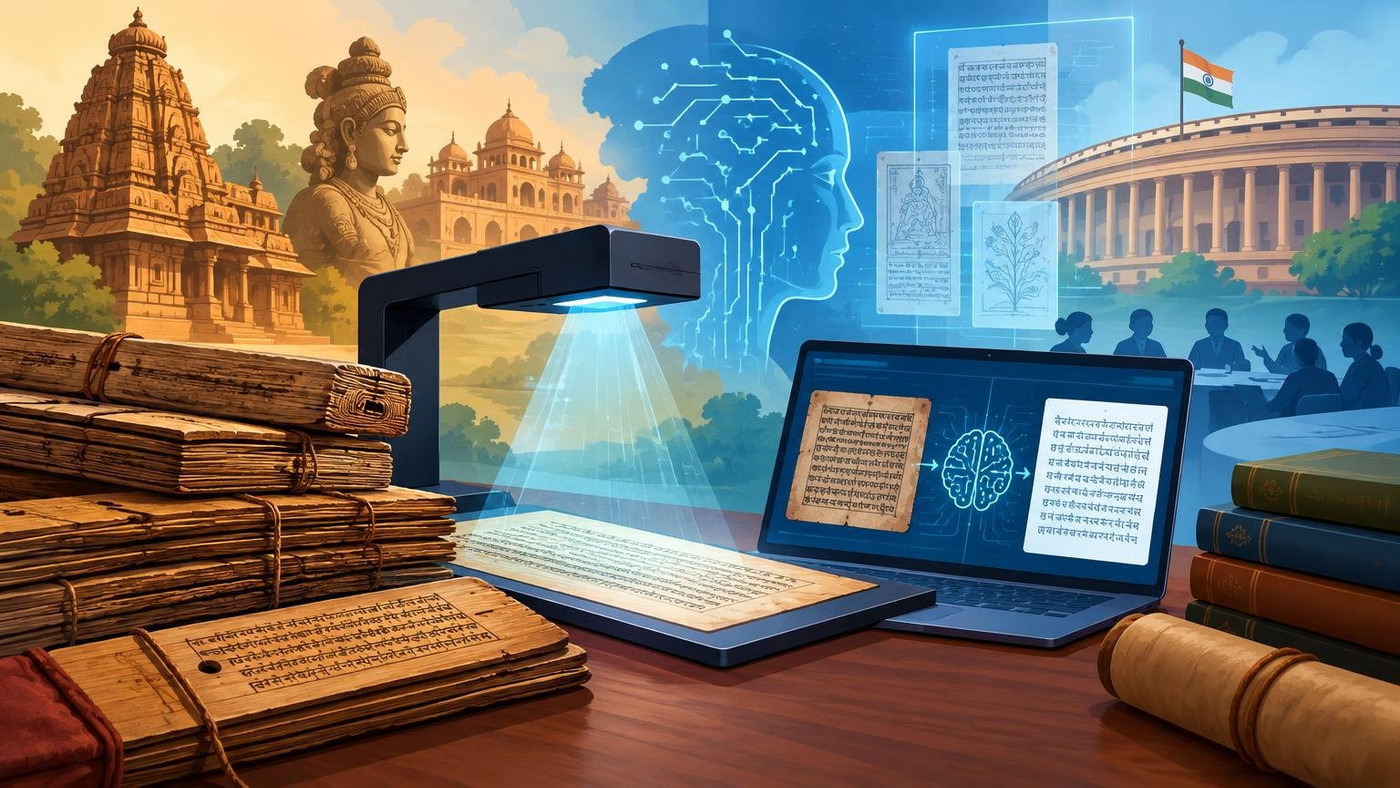
AI-generated representative image
India's Ministry of Culture is using artificial intelligence under the Gyan Bharatam Mission to digitise and decode manuscripts, while a parliamentary panel urges a wider AI-led roadmap.
What Happened
India's Ministry of Culture is using artificial intelligence (AI) under the Gyan Bharatam Mission to digitise and decode the country's manuscript heritage, according to a government data sheet issued on 18 June 2026. The sheet said more than 44 lakh manuscripts have been documented. The mission was announced in the Union Budget 2025-26. On 12 August 2026, the Parliamentary Standing Committee on Transport, Tourism and Culture presented its 393rd report on AI and cultural heritage to Parliament, proposing a wider AI-led roadmap.
Key Facts
- The Press Information Bureau (PIB) said on 10 September 2025 that Gyan Bharatam was allocated Rs 482.85 crore for 2024-31. Over 44.07 lakh manuscripts were already documented in the Kriti Sampada digital repository.
- Union Culture Minister Gajendra Singh Shekhawat told the Lok Sabha in a written reply in February 2026 that the Standing Finance Committee had sanctioned Rs 491.66 crore for 2025-2031.
- The mission aims to digitise and catalogue over one crore manuscripts and build a National Digital Repository (NDR). It plans to use AI, optical character recognition (OCR) and blockchain for transcription, access and tracking of origin.
- Only 1.29 lakh manuscripts are open to the public on the NDR, against over 44 lakh documented as of June 2026.
- The mission was formally launched at the first Gyan Bharatam International Conference at Vigyan Bhawan, New Delhi, from 11 to 13 September 2025. Culture Secretary Vivek Agarwal called it a national movement.
- The Ministry of Culture launched the Gyan Bharatam National Manuscript Survey on 16 March 2026 to map manuscripts held in personal collections, monasteries and libraries. It covers handwritten texts more than 75 years old.
- The National Mission on Monuments and Antiquities (NMMA), run under the Archaeological Survey of India (ASI), had documented 1.84 lakh monuments and sites and 17.20 lakh antiquities by March 2026.
- The committee's 393rd report is titled "From Manuscript to Mission: Preserving, Mapping and Sustaining India's Cultural Heritage in the Age of Artificial Intelligence". It was presented to the Rajya Sabha and laid in the Lok Sabha on 12 August 2026.
Why It Matters
Manuscripts on Ayurveda, astronomy, grammar, philosophy and ritual have long been held in private or fragile form. Digitisation can move them from monasteries, libraries and family collections to students and researchers. For India, it strengthens custodianship of Sanatan knowledge systems and links ancient traditions with modern tools.
Prime Minister Narendra Modi said at the 12 September 2025 launch that India holds the world's largest collection, about one crore manuscripts. He said digitisation would also help curb "intellectual piracy", since traditional knowledge is often copied and patented elsewhere. The mission also aims to bring together manuscripts held abroad.
The scale is large, and the numbers keep growing. At a National Digitization Drive Workshop in New Delhi, the Culture Ministry said more than 1.2 crore manuscripts had been reported nationwide. States are reporting their own counts: Punjab has identified 1,36,743 manuscripts, and Jammu and Kashmir 33,858. The gap between documenting a text and opening it to the public still shows how much work lies ahead.
AI helps with a slow task. A 200-page manuscript can take a trained expert two to two-and-a-half months to transcribe. AI can speed up that first step, while the scholar still does the interpretation. OCR, which reads text from images, is hard to do well on palm-leaf and birch-bark texts because scripts vary and the material fades. The ministry also launched Gyan-Setu, a national AI innovation challenge, in September 2025.
Experts also urge care. A 2026 research paper on digital preservation warns that AI-restored pixels, OCR text and interpretations are derived versions of the original. They must be checked by experts and labelled. Project Director Anirban Dash has described a two-phase approach that combines technical digitisation with scholarly validation.
Figures on funding differ by source and period:
| Source | Amount | Period |
|---|---|---|
| PIB, 10 September 2025 | Rs 482.85 crore | 2024-31 |
Impact
Short-term: The mission is moving from counting to digitising. The Ministry of Culture said in October 2025 that it would sign memorandums of understanding with about 50 institutions, 20 of them on 25 October 2025 and 30 more afterwards. In February 2026, the Uttar Pradesh government directed every district to identify and document manuscripts, with each district's Chief Development Officer as nodal officer. Districts are running surveys. Kaithal in Haryana had uploaded 387 manuscripts to the mission portal, and its Deputy Commissioner set a 10 June deadline for the survey. Jammu and Kashmir has planned a household drive called Har Ghar Dastak.
Long-term: The ministry's implementation plan runs in three phases from 2025 to 2031, covering setup, platform launch and wider outreach, and its final stage focuses on conservation support and high-quality digitisation. The parliamentary committee recommends national digitisation standards, including multispectral imaging for damaged manuscripts, detailed metadata, material records and scientific dating protocols. It also calls for an open national repository and global mapping of Indian manuscripts. These are committee recommendations, not government decisions, and the government has not announced whether it will adopt them.
Who is affected: Scholars and students gain wider access to texts that were once hard to reach. Custodians of manuscripts, including private collectors, monasteries and libraries, are being mapped and offered conservation support, and owners keep their manuscripts. The committee also suggests linking manuscript heritage to the PM Gati Shakti National Master Plan, building knowledge tourism circuits around cultural sites and connecting artisans to digital commerce. For built heritage, the ASI manages 3,686 centrally protected monuments as of April 2026, with about Rs 374 crore allocated for them in 2024-25. A Rs 300 crore initiative aims to bring AI into preserving artefacts and monuments.
Key Takeaway
As of June 2026, over 44 lakh manuscripts are documented under Gyan Bharatam, but only 1.29 lakh are open to the public on the NDR.
Questions and Answers
What is the Gyan Bharatam Mission?
Gyan Bharatam is a flagship Ministry of Culture initiative announced in the Union Budget 2025-26. It aims to find, protect and preserve India's manuscripts, digitise them with AI-driven tools and build a National Digital Repository for scholars and the public.
How many manuscripts has Gyan Bharatam documented?
A government data sheet issued on 18 June 2026 said more than 44 lakh manuscripts have been documented. Of these, only 1.29 lakh are open to the public on the National Digital Repository.
How much money is allocated to the Gyan Bharatam Mission?
The Press Information Bureau said on 10 September 2025 that Rs 482.85 crore was allocated for 2024-31. Minister Gajendra Singh Shekhawat told the Lok Sabha in February 2026 that Rs 491.66 crore was sanctioned for 2025-2031.
What did the Parliamentary Standing Committee recommend on AI and heritage?
Its 393rd report, presented on 12 August 2026, recommends national digitisation standards, an open national repository and global mapping of Indian manuscripts. These are recommendations, and the government has not announced whether it will adopt them.
Disclaimer: Prepared by the Peepals newsroom from publicly available sources with AI assistance. Information is accurate to the best of our knowledge at the time of publication and may change. Images may be representative. Not professional advice. Report an error via our contact page.
Sourced and fact-checked by the Peepals Global Editorial Team
Navratri and Durga Puja 2026: Dates and Significance of October Festivities
Pitru Paksha 'Gratitude towards Ancestor'
Reported, fact-checked and published by the Peepals Global Editorial Team.