
Vishwarang 2026 in Bihar puts India's languages and knowledge traditions in focus

Representative image: svecaleksandr249 / Pixabay
The eighth Vishwarang festival, held in Vaishali, Patna and Nalanda from October 3 to 8, 2026, focused on Indian knowledge traditions, translation and Asian ties.
What Happened
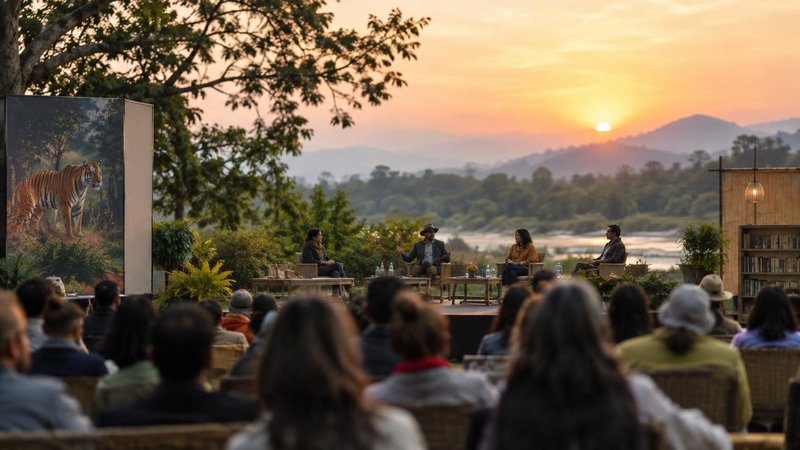
The eighth edition of Vishwarang, a festival of Indian languages, literature and culture run by Rabindranath Tagore University in Bhopal, was held in Bihar from October 3 to 8, 2026, with sessions in Vaishali, Patna and Nalanda. It began on October 3 at C.V. Raman University in Vaishali, held its main inaugural programme on October 4 at the Patna Museum, and closed with a two-day segment at Nalanda University on October 7 and 8. The discussions covered the Indian knowledge tradition, linguistic diversity, translation between Indian languages, folk traditions and India's historical and cultural links with South and South-East Asia.
Key Facts
- Vishwarang is organised by the Vishwarang Foundation and Rabindranath Tagore University, Bhopal; Santosh Choubey, the university's chancellor, is the festival's director.
- The 2026 edition, its eighth, ran from October 3 to 8 across Vaishali, Patna and Nalanda.
- The first phase opened on October 3 at C.V. Raman University, Vaishali; the main programme was inaugurated on October 4 at the Patna Museum.
- The Nalanda segment on October 7 and 8 focused on dialogue between North-East India and South-East Asia.
- Sessions on October 8 covered the linguistic and cultural influence of Buddhist philosophy in South Asian countries, and trade and sustainable development.
- Nalanda University Vice-Chancellor Sachin Chaturvedi said the university was working with Bhashini, the government's language-technology platform, to use technology to overcome language barriers.
- The programme included readings of works translated from Indian languages, multilingual poetry recitations and music.
Why It Matters
Much of India's traditional knowledge, from philosophy and medicine to grammar and astronomy, was written and passed on in many languages, not one. Some of it survives only in regional languages, and a great deal has never been translated into the languages most students read today. A festival that puts translation and linguistic diversity at its centre is, in effect, working on the problem of access: how a reader in one language can reach ideas first written in another.
Holding the 2026 edition in Bihar gave the theme a natural setting. Nalanda was one of the great centres of learning of the ancient world, and Vaishali and the wider region are closely tied to the history of Buddhism. Sessions on how Buddhist philosophy shaped language and culture in South Asian countries, and on links between North-East India and South-East Asia, connected that history to India's relationships with its neighbours today.
The mention of Bhashini points to where this work may go next. Machine translation tools trained on Indian languages could help make old texts and new scholarship available across languages at a scale that human translators alone cannot manage, though quality and accuracy remain challenges for scholarly material.
For students and researchers, events like Vishwarang are also a place to meet writers, translators and academics working across languages, and to see how literary and knowledge traditions are being studied in universities outside the largest cities.
| Date | Venue | Focus |
|---|---|---|
| October 3 | C.V. Raman University, Vaishali | Opening phase |
| October 4 | Patna Museum | Main inauguration; Indian culture, South and South-East Asian links, art and literature |
| October 7-8 | Nalanda University | North-East India and South-East Asia dialogue; Buddhist philosophy; trade and sustainable development |
Impact
Short-term: The festival brought writers, scholars and students in Bihar together around translation and India's language traditions.
Long-term: Linking universities with language-technology efforts such as Bhashini could widen access to texts in Indian languages for readers who do not know the original language.
Who is affected: Students and researchers in languages, literature and Buddhist studies, translators and writers, and universities in Bihar and Madhya Pradesh.
Key Takeaway
The eighth Vishwarang festival, held in Vaishali, Patna and Nalanda from October 3 to 8, 2026, focused on India's knowledge traditions, translation and cultural ties with South and South-East Asia.
Questions and Answers
What is Vishwarang?
Vishwarang is a festival of Indian languages, literature and culture organised by the Vishwarang Foundation and Rabindranath Tagore University, Bhopal. Its 2026 edition was its eighth.
Where and when was Vishwarang 2026 held?
It was held in Bihar from October 3 to 8, 2026, in Vaishali, at the Patna Museum and at Nalanda University.
What topics did the festival discuss?
Sessions covered the Indian knowledge tradition, linguistic diversity, translation, folk traditions, Buddhist philosophy's influence on South Asian languages and culture, and India's links with South-East Asia.
What role does technology play?
Nalanda University's Vice-Chancellor said the university is working with Bhashini, the government's language-technology platform, to help overcome language barriers.
Disclaimer: Prepared by the Peepals newsroom from publicly available sources with AI assistance. Information is accurate to the best of our knowledge at the time of publication and may change. Images may be representative. Not professional advice. Report an error via our contact page.
Sourced and fact-checked by the Peepals Global Editorial Team
CGHS gives Ayush hospitals until November 30 to finish online re-empanelment
MP Ayush interns step up stipend protest, seek Rs 21,500 parity with MBBS
Reported, fact-checked and published by the Peepals Global Editorial Team.