
Chemistry Nobel 2026 goes to Kagan and Soai for work on 'mirror-image' molecules
AI-generated illustration
Advertisement
Henri Kagan and Kenso Soai won the 2026 Nobel Prize in Chemistry on October 7 for showing how one mirror-image form of a molecule can come to dominate, work vital to drug-making.
What Happened
The Royal Swedish Academy of Sciences awarded the 2026 Nobel Prize in Chemistry on Wednesday, October 7, 2026, to Henri B. Kagan of Universite Paris-Sud in France and Kenso Soai of Tokyo University of Science in Japan. The academy cited their discoveries of non-linear effects and autocatalysis in asymmetric organic synthesis. In simple terms, the two chemists showed how reactions can produce far more of one "mirror-image" version of a molecule than the other, helping to answer a century-old question about why living things use only one version of key molecules such as amino acids. The two share the prize of 12 million Swedish kronor, about 1.2 million US dollars.
Key Facts
- Laureates: Henri B. Kagan (France) and Kenso Soai (Japan).
- Announced: October 7, 2026, by the Royal Swedish Academy of Sciences.
- Citation: non-linear effects and autocatalysis in asymmetric organic synthesis.
- Kagan showed in 1986 that a catalyst's handedness does not pass to the product in a simple one-to-one way, so a reaction can yield more of one mirror form than expected.
- Soai designed a reaction, now called the Soai reaction, in which a tiny excess of one mirror form amplifies itself until that form dominates.
- The academy said the work has been revolutionary for chemists making pharmaceuticals, flavours, scents and new materials.
- Prize money: 12 million Swedish kronor, shared equally.
Why It Matters
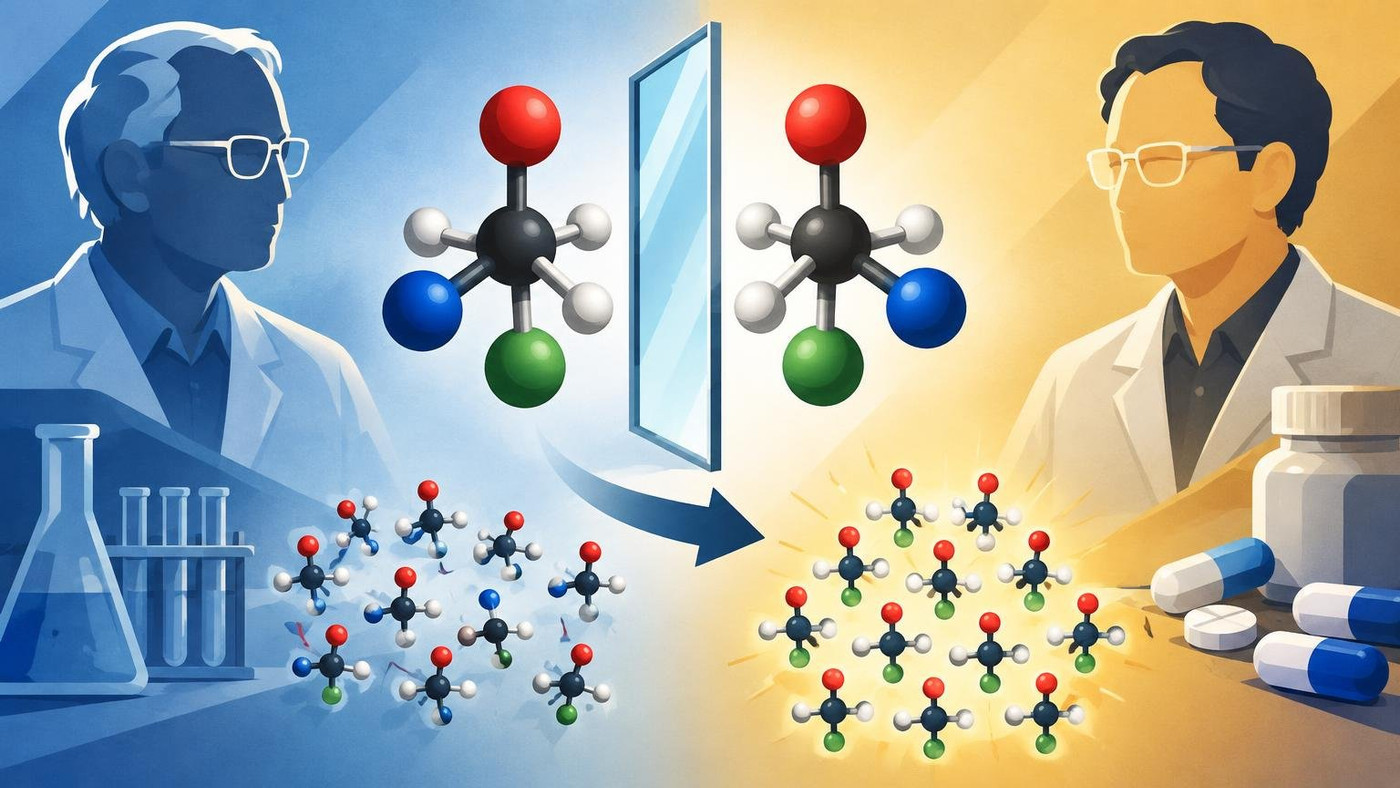
Many molecules come in two forms that are mirror images of each other, like a left and a right hand. Chemists call this property chirality. The two forms contain the same atoms but can behave differently in living systems. Life itself uses only one form of amino acids, the building blocks of proteins. Why nature picked one hand has puzzled scientists for more than a hundred years. Kagan's and Soai's work showed how a small imbalance between the two forms can grow on its own into an overwhelming majority, offering a chemical route to that one-handedness.
The practical value is large. Making a medicine with only the correct mirror form is often essential for safety and effectiveness, and doing it efficiently saves money and waste. The methods built on this research help chemists control which form a reaction produces, which matters to every company that makes modern drugs.
That is why the prize is relevant to India, where drug manufacturing is a major industry and chemistry research is carried out in universities and national laboratories. Advances in controlling chirality feed directly into how active drug ingredients are made, how pure they are and how much they cost. For Indian students and researchers, the award is also a reminder that basic questions, such as why life is one-handed, can lead to technologies with huge economic impact.
| Laureate | Affiliation | Key contribution |
|---|---|---|
| Henri B. Kagan | Universite Paris-Sud, France | Non-linear effects in asymmetric reactions (1986) |
| Kenso Soai | Tokyo University of Science, Japan | Self-amplifying (autocatalytic) Soai reaction |
Impact
Short-term: The prize brings attention to asymmetric synthesis and chirality research, which may help attract students and funding to the field.
Long-term: Better control over mirror-image molecules supports cleaner, cheaper and safer production of medicines, flavours and new materials, and deepens scientific understanding of how life began.
Who is affected: Pharmaceutical and fine-chemical manufacturers, chemistry researchers and students, regulators who judge drug purity, and patients who depend on safe medicines.
Key Takeaway
The 2026 Chemistry Nobel honours Henri Kagan and Kenso Soai for showing how one mirror-image form of a molecule can come to dominate, a discovery that matters both for drug-making and for understanding life.
Questions and Answers
Who won the Nobel Prize in Chemistry in 2026?
Henri B. Kagan of France and Kenso Soai of Japan. It was announced on October 7, 2026.
What is chirality?
It is the property of molecules that exist in two mirror-image forms, like left and right hands. The two forms can behave very differently in the body, which is why it matters for medicines.
What did Kagan and Soai discover?
Kagan showed in 1986 that reactions can produce more of one mirror form than a simple one-to-one rule predicts. Soai created a reaction in which a small excess of one form multiplies itself until it dominates.
Why does this matter for medicines?
Many drugs must be made in only one mirror form to be safe and effective. Methods for controlling which form is produced help manufacturers make purer medicines more efficiently.
Sourced and fact-checked by the Peepals Global Editorial Team
OpenAI brings GPT-6 to all ChatGPT users, including free and Go plans
Bengaluru's Desible.ai raises Rs 32 crore for AI agents that serve banks and insurers
Reported, fact-checked and published by the Peepals Global Editorial Team.
Advertisement